
Rare Earths and AI Chips: From Mine to Data Center
Rare earths and AI chips: the chip barely contains these elements, but cannot exist without them. See the path to the data center and why China leads refining.
 NinaKalkazu.org
Listen to this article
Narrated by Thalita
Every time China tightens mineral exports, the same headline appears: the war over artificial intelligence chips now runs through rare earths. Then comes the natural question: how does a handful of powder pulled from a mine become the board that trains ChatGPT?
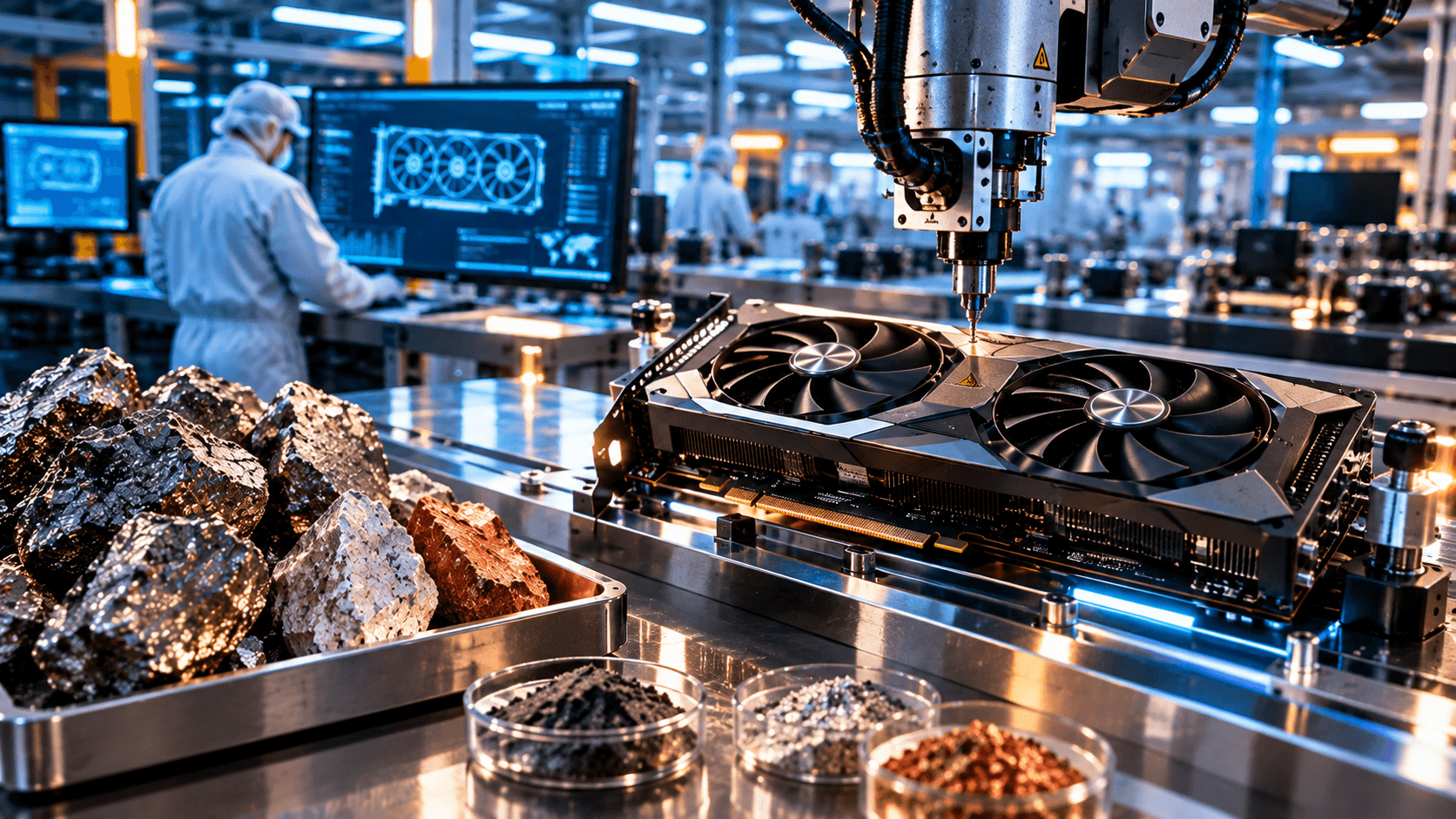
The answer has a trick. Rare earths and AI chips are connected, but not the way you might think. The chip barely contains any rare earth inside. They surround it, from polishing at the factory to the turbine that generates power for the data center (the warehouse full of computers where AI runs).
Quick summary: the answer in 30 seconds. Rare earths are 17 chemical elements that, despite the name, are not scarce. The hard part is separating them, and China does about 91% of refining. Inside the AI chip they barely appear. But without them you cannot polish silicon or make board components, magnets, fibers and turbines. That is why they became bargaining chips between the US and China.
Index
- Rare earths and AI chips: the short answer
- What rare earths are (and are not)
- From mine to oxide: the bottleneck is separation
- What rare earths are used for in chip factories
- What rare earths are used for in AI data centers
- Rare earths and China: the bargaining chip for chips
- Rare earths in Brazil: large reserve, small chain
- What this changes for AI users
- Frequently asked questions
Rare earths and AI chips: the short answer
A GPU (the chip that does AI calculations, like thousands of calculators together) is made of silicon, copper and other metals; rare earths barely enter it. They are tools and infrastructure: they are in the powder that polishes silicon, in the machines that etch circuits, in board components, in disks, in fibers and in turbines.
Think of a bakery. Bread does not contain steel, but without the steel oven there is no bread. Rare earths are the oven, not the flour.
John Heron, professor of materials engineering at the University of Michigan, told IEEE Spectrum that they are not part of the chip itself, but are necessary to manufacture it. A rare earth cutoff does not stop chip design; it stops the factory and data center power.
What rare earths are (and are not)
Rare earths are 17 chemical elements: the 15 lanthanides (the loose row at the bottom of the periodic table), plus scandium and yttrium. The name is misleading. According to MIT Technology Review, "rare" refers to the fact that they are scattered, not to scarcity: it is hard to find them together in quantities that pay for mining.
Imagine salt mixed throughout all the sand on a beach, without forming a pile: there is plenty, the work is gathering it.
Gallium, germanium and hafnium: the neighbors that confuse
Many reports lump gallium, germanium and hafnium in the same bag. None of the three is a rare earth. They are critical minerals, a broader category of materials at risk of shortage.
These three get even closer to the chip. Hafnium forms the insulating layer of transistors, the microscopic switches that the chip has by the billions. Gallium and germanium appear in radio chips, LEDs and optical fibers. China began requiring licenses to export the two in August 2023, as MIT Technology Review explained.
| Element | Is it a rare earth? | Where it appears in the AI chain |
|---|---|---|
| Yttrium | Yes | Plasma chambers, capacitors, turbines |
| Erbium | Yes | Optical fiber amplifiers |
| Cerium | Yes | Wafer polishing |
| Neodymium | Yes | Hard disk magnets |
| Hafnium | No | Insulator inside the transistor |
| Gallium and germanium | No | Radio chips, LEDs, optical fiber |
From mine to oxide: the bottleneck is separation
The hardest step is not digging, it is separating. Rare earths come out of the mine mixed, with almost identical chemistry, and go through many stages to become pure oxides, the sellable powder of each element. This is where China dominates, with about 91% of the refining of rare earths used in magnets, such as neodymium and dysprosium.
The number is from the International Energy Agency (IEA), with 2024 data. In mining, China's share is smaller: according to the 2026 report from the US Geological Survey (USGS), China extracted 270 thousand of the world's 390 thousand tons in 2025, close to 69%.
Separating such similar elements is like dividing identical twins by smell: it can be done, but requires repeating the process many times, with lots of acid and lots of waste. Strict environmental rules made this expensive in the West, and China filled the space.
The result appears in a phrase from Eric Bender, executive at Tronox, to IEEE Spectrum: he says he knows no one outside China who produces erbium oxide at commercial scale.
What rare earths are used for in chip factories
In the factory, rare earths work as tools. Cerium enters the powder that smooths each layer of the wafer (thin silicon disk where chips are printed). Yttrium protects the walls of machines that etch circuits with plasma. Neither stays in the finished chip, but without them the production line loses quality or stops more often.
Cerium in wafer polishing
Cerium oxide is one of the powders in CMP, chemical-mechanical polishing: a kind of superfine wet sandpaper that sands and dissolves at the same time. American patents, such as US 8,439,995, describe cerium as faster than silica powders, the material of sand. Each layer needs to be flat before the next. For chips, it needs to be extremely pure, or it scratches the layer.
Yttrium in plasma chambers
To etch circuits, machines fire plasma (electrified gas, so aggressive it corrodes metal) at the wafer. The plasma also attacks the machine walls, and worn parts release particles that contaminate the chip.
The solution is to coat parts with yttrium oxide, which withstands the attack, as described in patent US 7,311,797.
What rare earths are used for in AI data centers
Outside the factory, the list grows. Yttrium is in board capacitors and in turbines that generate power. Neodymium is in hard disk magnets. Erbium is in amplifiers that keep light alive in fibers between data centers. This is where AI depends on them most.
Yttrium in capacitors next to the GPU
A capacitor is a mini-battery that stores and releases energy in fractions of a second, so the chip does not suffer from fluctuations. Small doses of yttrium and dysprosium, another rare earth, enter the ceramic of these components to reduce electricity leakage, as patents such as CN101960543B describe. Consultant Thomas Kruemmer told IEEE Spectrum that yttrium ends up in trillions of these capacitors.
Neodymium in hard disk magnets
Training AI requires storing lots of data, and much of mass storage still uses hard disks. The arm that reads the disk is moved by a magnet of neodymium, iron and boron, one of the strongest permanent magnets industry uses.
IEEE Spectrum reported an estimate from Idaho National Laboratory: about 20 million disks leave large American data centers per year. Recycling these magnets became an alternative source studied in the US.
Erbium in fibers connecting data centers
Data centers communicate by optical fiber, and light loses strength along the way. Every stretch, an amplifier with fiber that carries a bit of erbium in the glass boosts the signal without converting it to electricity. Erbium works near 1,550 nanometers, a color of light invisible to the eye and the one that loses least in fiber, as a scientific study in arXiv, a research repository, shows.
Yttrium in turbines that generate power
Data centers consume lots of energy, as we showed in the article about the energy bill of AI data centers. Many new ones use gas turbines, whose blades work in heat that would melt metal.
The protection is a ceramic of zirconia with yttrium, a kind of enamel that withstands fire. NASA tested this coating on turbine blades in the 1970s and considered it the best among those evaluated. According to IEEE Spectrum, demand for these turbines in the US is at record level, driven by data centers.
Rare earths and China: the bargaining chip for chips
Since 2023, China has responded to American chip restrictions with mineral restrictions. In April 2025, it began requiring licenses for seven rare earths, including yttrium. In October, it included five more, including erbium. In November, it suspended the October rules for a year; the April ones remain in effect.
The dates and elements are in the USGS report. The October package was the toughest: according to TechCrunch, it required licenses even from foreign companies whose products had small amounts of Chinese rare earths. The US threatened an extra 100% tariff on Chinese products, and the parties reached a truce in early November.
The truce expires on November 10, 2026, and Beijing has not yet announced whether it will renew it (checked on October 16, 2026). The topic moves together with the chip dispute we follow in the article about the first official conversation between the US and China about AI.
Rare earths in Brazil: large reserve, small chain
Brazil has the world's second largest rare earth reserve, about 11 million tons, behind only China, according to the USGS. But it produced only 2 thousand tons in 2025, close to 0.5% of the world total. Having ore in the ground is not enough: the separation stage is missing.
| Country | Reserve (tons) | 2025 production (tons) |
|---|---|---|
| China | 44 million | 270 thousand |
| Brazil | 11 million | 2 thousand |
| Australia | 6.3 million | 29 thousand |
| US | 1.9 million | 51 thousand |
Production nearly quadrupled since 2024 (560 tons), but separation and refining in Brazil are still lacking.
What this changes for AI users
In the short term, almost nothing in your wallet. The amount of rare earth per chip is small and weighs little in the final price. The real risk is delay: if yttrium runs short for turbines or capacitors, new data centers take longer to turn on, and AI capacity grows more slowly.
| If you are… | What to watch | Why |
|---|---|---|
| User of ChatGPT, Claude or Gemini | Nothing in the short term | Subscription price depends more on GPU and energy |
| Company contracting cloud | New data center timelines | Lack of turbines and parts delays capacity |
| Investor or geopolitics watcher | The November 10 deadline | Determines whether October 2025 rules return |
| Interested in Brazil | Separation projects in the country | It is the stage that turns reserve into industry |
Frequently asked questions
What are rare earths?
They are 17 chemical elements: the 15 lanthanides, plus scandium and yttrium. They are not scarce, but rarely appear concentrated.
What are rare earths used for?
The most common worldwide use is in strong magnets, from electric cars to hard disks. They also serve to polish glass and silicon and in heat-resistant ceramics.
Is there rare earth inside the AI chip?
Almost none in the part that calculates. They are in the machines that manufacture the chip, in capacitors and in data center infrastructure.
Why does China control rare earths?
Because it dominates separation and refining, the dirtiest and most expensive stage. With that, it uses exports as a negotiating instrument.
Can Brazil compete with China in rare earths?
It has the reserve for it. What is missing is mining scale and, mainly, separation and magnet factories.
The path of rare earths to AI is indirect, but it is through it that the factory, power and cable of each chatbot response pass. Keep an eye on November 10 and follow the next chapter in our artificial intelligence category.