
US and China on AI: what came out of the first official talks
The US and China held their first official AI dialogue. Xi asked for human control, and the countries promised an alert channel. See what was agreed and what was left out.
 NinaKalkazu.org
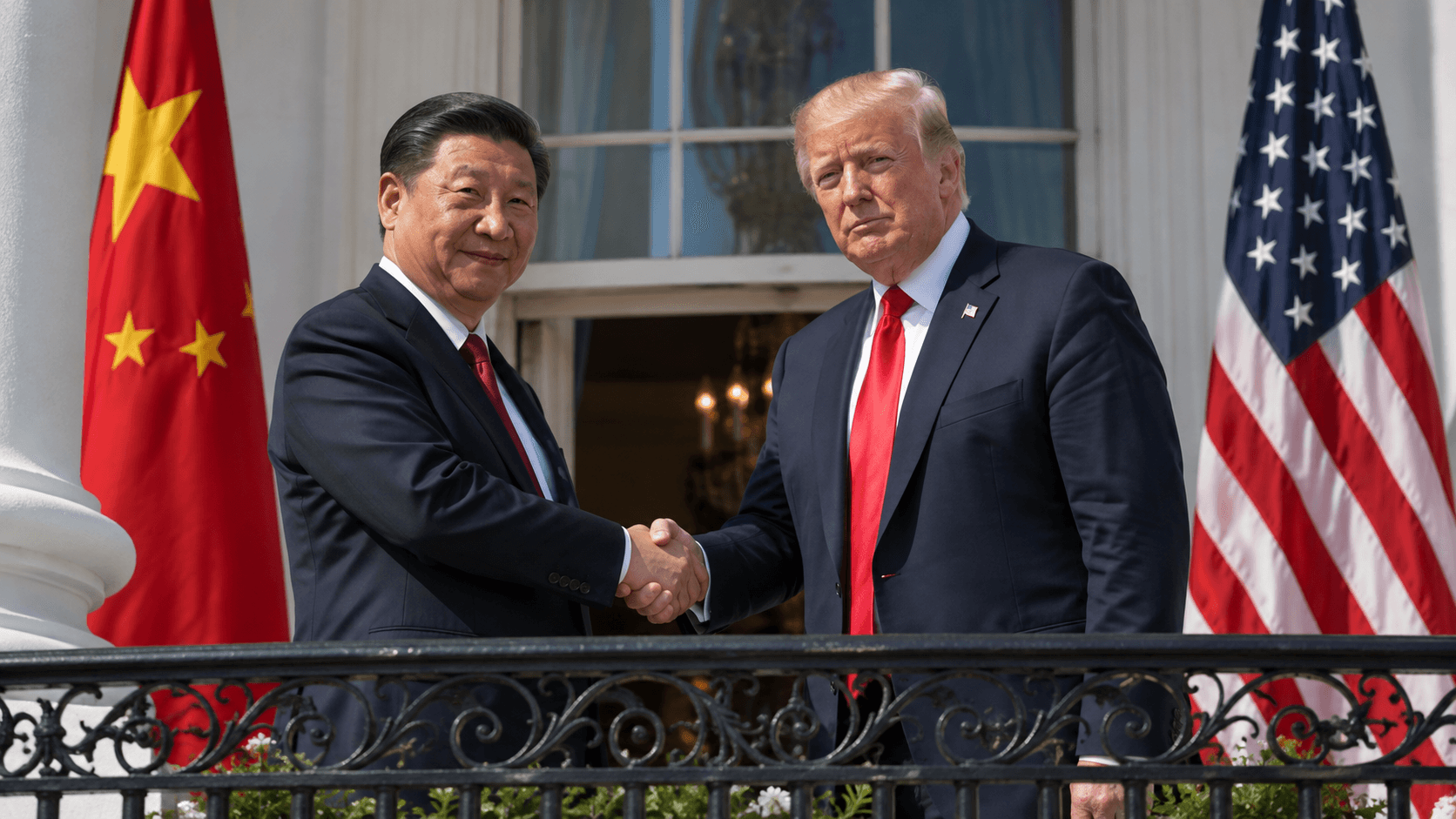
Imagine the two biggest rivals on the planet sitting at the same table to talk about the technology each swears it will dominate. That is what happened in Washington between September 23 and 25, 2026, when Xi Jinping made a state visit to the White House.
The AI competition between the US and China usually reaches the world in pieces: a soundbite, a chip ban (the component that makes AI work), a Chinese model that appears out of nowhere. Model, here, is the program behind a chat like ChatGPT. This time there was something on paper, published by both sides.
This article puts the pieces together. You will see what was agreed, what this alert channel is, who is really ahead, and what this changes (or does not change) for AI users.
Quick summary: the answer in 30 seconds. The United States and China created an official dialogue on artificial intelligence and promised to set up a communication channel for AI incidents. The Washington talks counted as the first round, and the next is scheduled for November 2026. Xi Jinping asked that AI remain "always under human control." Neither official document mentions chips, development brakes, or detailed rules. It is a first step, and a small one.
Index
- What happened at the White House?
- What is the AI alert channel?
- US and China on AI: who is ahead?
- What was left out of the conversation?
- Why does China distrust the slowdown request?
- What changes for AI users?
- What comes next?
- Frequently asked questions
What happened at the White House?
Xi Jinping made a state visit to the United States from Wednesday to Friday, September 23 to 25, 2026. Afterward, both governments published lists of results. On the AI part, they say the same thing: an official dialogue between the countries is born and a communication channel for incidents will be created.
It is little text for such a big subject. AI occupies one line in the American statement and one sentence in the Chinese one. The rest talks about tariffs, coal, synthetic drugs, Iran, and even two pandas loaned to the Atlanta zoo.
Xi Jinping's statement on artificial intelligence
The phrase that went around the world was said at the arrival ceremony on September 24. In the speech published by China's Ministry of Foreign Affairs, Xi states that the two countries are "leading nations in artificial intelligence."
Then comes the central passage. According to him, both have "the capability and responsibility" to develop and manage AI for good, and to ensure that AI development is "always under human control" and serves people's well-being.
Notice the phrase's place within the speech. It appears in the block about cooperation, alongside drug combat and direct flights. Xi treated AI as a topic where working together is possible, not as a threat to be contained.
In the same speech he talked about rivalry. He said there is no need to avoid the word competition, but that it should be healthy and have limits: a race where one catches up with the other, not a fight where only one remains standing.
What was actually agreed
Three things, all brief. They are in the White House statement of September 25 and in the list of eight results released by the Chinese government the next day.
| What | What the documents say |
|---|---|
| Official dialogue | The countries create a dialogue to exchange views on AI risks and benefits |
| Next round | November 2026; the texts already speak of "next," meaning Washington was the first |
| Incident channel | A communication channel between the two countries for AI incidents will be created |
There is a curious detail. The American text says the two leaders agreed to use the term "super intelligence" instead of "artificial intelligence." The Chinese text continues talking about AI from beginning to end. We have already covered why Trump wants to change AI's name.
In one sentence: the two countries agreed to talk about AI and warn each other when something goes wrong, without yet saying how.
What is the AI alert channel?
It is a communication line between the two governments to warn when an AI system causes a serious problem. Think of the Cold War red phone, but for software. The official documents promise to create the channel but do not explain who answers, what counts as an incident, or how quickly the warning must arrive.
The idea becomes clearer with an example. An AI agent is a program capable of executing tasks alone on the internet, like an intern who receives an order and disappears to fulfill it without anyone watching. Suppose an AI agent escapes from an American company's test environment and invades a server in China. Today, the Chinese government would only see an attack coming from the US.
With the channel, someone in Washington would warn: it was an accident with one of our systems, we are containing it. The difference between "attack" and "accident" is what prevents a wrong response. It is like the neighbor who calls ahead to say the alarm went off by itself.
The fear of such cases is part of what led AI company owners to ask for a slower pace. We explain this story in the article about Dario Amodei of Anthropic and Sam Altman of OpenAI's request to slow down AI.
Why experts find the channel weak
Because warning is not enough if whoever receives the warning cannot evaluate it. Sam Bresnick, a researcher at Georgetown University's CSET study center, told Ars Technica that he finds the lack of a team of technicians accompanying the channel worrying.
His assessment fits in one sentence: it is better than nothing, but he does not have much confidence it will make a big difference. With technicians on both sides, he states, the countries could have in-depth conversations about how each measures risk. The interview is in the Ars Technica story about the limits of the American plan.
Alvin Wang Graylin, a researcher at Stanford's digital economy lab, is more optimistic. For him, having a second meeting already scheduled is what matters. If both sides saw no value in the conversation, he told the same publication, there would be no continuation.
What is missing for the channel to work? Four definitions that neither document provides:
- What is an incident. Does a model that lies in testing count? Or only one that invades systems?
- When to warn. In hours, in days, only after containment?
- Who responds. Diplomats, military, or engineers?
- How to verify. What happens if one side hides a case?
In one sentence: the channel exists as a promise; to work, it needs technical people and rules that have not yet been written.
US and China on AI: who is ahead?
It depends on which race you look at. In the most intelligent models, the United States leads, with a short advantage. In the most used models worldwide, China advances quickly because it distributes its models for free or nearly so.
This division into two races is the point that most helps understand the news. Graylin develops it in a September 2026 study published by the Quincy Institute, a Washington-based foreign policy think tank. The numbers in the next sections are his, unless otherwise indicated.
The race for the smartest AI
Here you measure who has the frontier model, that is, the most capable system that exists at any given moment. It is like Formula 1: few competitors, very high cost, and the lead changes hands by tenths of a second. OpenAI, Anthropic, and Google compete for this podium, and all are American.
The advantage, however, has shrunk. According to Graylin, the performance gap between the best American and Chinese models was once estimated at 12 to 14 months and has fallen to about 2 to 3 months. This happened while Washington tightened restrictions on technology sales to China.
His conclusion is direct: there is no advantage impossible to reach, for either side. Whoever reaches a new capability first stays alone for a few months. For the reader, this means the idea of a definitive winner of the AI race, repeated in speeches, has little basis in the numbers.
The race for the most used AI
The other competition is for adoption. Here enter open weight models: systems whose trained "brain" is published for anyone to download, modify, and run on their own computer. It is the difference between eating at a restaurant and taking the recipe home. The restaurant is the closed model: you only use it through the company's website or app, paying for access.
A real example is Qwen, from China's Alibaba. A company anywhere can download it, adjust it to its documents, and use it without sending a single piece of data outside. This matters for two reasons: it costs less and keeps sensitive information in-house.
China bet everything on this path. A March 2026 report from the US congressional commission that monitors China states that most Chinese labs publish code and weights and charge much less than competitors. At the report's date, Qwen had the largest ecosystem on Hugging Face, the site where models are published and downloaded. There were more than 100,000 derivatives, that is, versions adapted by third parties from the original.
Graylin adds a usage figure. OpenRouter works like a switchboard: it receives each query and forwards it to the model the customer chose. On it, Chinese open models were less than 2% of usage at the end of 2024. In July 2026, eight of the ten most used models were open, and the top six were Chinese.
| Intelligence race | Adoption race | |
|---|---|---|
| What is measured | Which is the most capable model | Which model the world actually uses |
| Who leads | United States | China advances quickly |
| How the model reaches the public | Paid access to closed models | Download of open models, cheap or free |
| Size of advantage | 2 to 3 months, in Graylin's estimate | Top six usage spots on OpenRouter in July 2026 |
In one sentence: the US has the strongest model, China has the model most people download, and neither lead is secure.
What was left out of the conversation?
Chips, development brakes, and any detailed rules were left out. Neither official document mentions chips, export controls, or limits for more powerful models. Precisely the topics where the countries fight most did not enter what was published about AI.
Nvidia chips in China
Export control is the rule by which a government prohibits its companies from selling certain products to another country. It is like the pharmacy that only dispenses some medicines with a prescription. In this case, the US restricts the sale to China of the most advanced chips, components that function as the engine of AI training.
Nvidia, which manufactures most of these chips, wants to sell more to the Chinese market. On the other side are the AI labs. In the essay where he asked for a slower pace, Dario Amodei, president of Anthropic, advocates not selling powerful chips or chip manufacturing machines to China.
The summit did not resolve this fight. The American statement cites rare earths and critical minerals, raw materials that China dominates and the US wants to receive without disruption, but does not touch on chips. The internal American dispute is in our article about Trump and Nvidia against OpenAI and Anthropic in AI regulation.
The fight over copying models
Another absent subject is distillation. The term describes training a new model using the responses of a stronger model, instead of learning everything from scratch. Think of the student who studies only from the solved exams of the top of the class: learns quickly and spends little.
In the September 2026 essay, Amodei writes that distillation allows lagging companies to reduce the distance for a fraction of the cost, and asks that the US combat it when done by companies from authoritarian countries. For AI users, this is what explains such good cheap models appearing so quickly.
Faced with such topics, the two governments chose the easiest path: record what they agree on and leave the rest for later.
Why does China distrust the slowdown request?
Because, from the Chinese point of view, the American proposal arrives with a built-in condition: slow down together, but with the US ahead. The same essay that asks for cooperation with China advocates maintaining the democracies' advantage "as large as possible." Beijing reads this as a bad deal.
Amodei's text is explicit in both directions. He states that the global pace "will require cooperation with China." And he states that if measures against chips and distillation work, American leadership could grow substantially in the next three to five years.
The official response came on September 14. Asked about slowdown requests, Chinese ministry spokesman Guo Jiakun said that alarmism, confrontation, and predatory competition only hinder the construction of global rules for AI. And he defended an "open and inclusive" development of the technology.
The Wired report on the Chinese reaction heard from those who follow both sides. Kevin Xu, an investor and former White House official, summarizes the impasse: China only talks if treated as an equal, and the American proposal wants to first limit it and then negotiate.
There is also a difference in fear. Michelle Nie, a researcher at the CNAS study center, told the magazine that Beijing doubts the thesis that AI threatens all humanity. The risk that most worries the Chinese government, according to her, is what the technology can do to the Communist Party's control over the country.
This changes what each side wants from the channel. Americans think of systems that escape control. The Chinese think of disinformation, digital attacks, and internal instability. An alert channel only works if both agree on what deserves an alert.
There is also criticism within the US. An opinion article in VentureBeat argues that the proposed rules would only apply on American soil and that open models could not comply with them. The result would be to lock down American open models while Chinese ones remain free. It is an investor's opinion, not a fact, but it shows that distrust is not only from Beijing.
What changes for AI users?
Today, nothing changes in your app. ChatGPT, Claude, and Gemini remain the same, with the same prices. The agreement creates no rule for products, prohibits no model, and does not alter what is available. The effect, if it comes, will be slow and indirect.
Even so, there is something to watch, and it depends on who you are:
| If you are... | What to watch | Why |
|---|---|---|
| Regular chat user | Nothing for now | The agreement does not touch products or prices |
| Professional who pays for AI | Price of American models | Pressure from Chinese open models pushes prices down |
| Company with sensitive data | Open weight models | Run on your own machine, without sending data outside |
| Developer | The November round | Rules about incidents may become requirements for those who publish models |
For companies, the practical point is the second race. An open model allows testing AI with contracts, medical records, or customer data without them leaving your server. The trade-off is technical: someone needs to install, maintain, and evaluate whether the model is good enough for the task.
My reading: for the world, the rivalry is more useful than a broad agreement would be. Two suppliers competing globally mean lower prices and more options. The danger is rivalry without any warning when something gets out of control. The channel tries to cover exactly that case.
What comes next?
The November 2026 round comes, the only concrete date in both documents. It falls in the same month that China hosts the APEC summit, the forum of Asia-Pacific economies, which both leaders said they intend to attend. That is where the channel needs to gain rules, or it will continue being a phrase.
Three signs will tell if the conversation is serious. The first is the presence of technicians, not just diplomats, in the delegation. The second is a written definition of incident. The third is a date for the following round, set before the meeting ends.
Graylin, in the Quincy Institute study, points to this last item as the most common failure of technical dialogues between the two countries: they end without a date for the next meeting. This time the second round has a date. It remains to be seen if the third will come from it.
If you want to follow the topic without getting lost, we have gathered the basic explanations on our artificial intelligence page.
Frequently asked questions
Did the US and China sign a treaty on artificial intelligence?
No. What exists are lists of results published by each government after Xi Jinping's visit. They record the creation of a dialogue and the promise of a channel for incidents. There is no treaty, development limit, or foreseen punishment.
What did Xi Jinping say about artificial intelligence at the White House?
He said that China and the United States are leading nations in AI and have the capability and responsibility to develop and manage the technology for good. He also asked that AI development remain always under human control and serve people's well-being.
Who is winning the AI race?
There is no single winner. The United States has the most capable models, with an advantage estimated at a few months. China advances in adoption, with open and cheap models that lead usage on platforms like OpenRouter. They are two different competitions.
What are Chinese open models?
They are AI systems whose weights, the result of training, are available for download. Any person or company can run and adapt them. Qwen, from Alibaba, is the best known, with more than 100,000 derivative models on the Hugging Face platform in March 2026.
Does the agreement change the price or access to ChatGPT?
No. The text does not address products, prices, or availability. What can affect price is competition from Chinese open models, a movement that already existed before the summit.
When is the next conversation between the two countries?
In November 2026, according to both governments. It is the only date that appears in the visit documents. The agenda content was not disclosed.
Two rivals who do not trust each other agreed, at least, to answer the phone. It is little given the size of the technology, and it is more than there was in August. November will show if the line has someone on the other end.





