
AI firing: what California's law prohibits
California bans firing by AI alone and requires disclosure in mass layoffs caused by automation. See what the law covers and where it falls short.
 NinaKalkazu.org
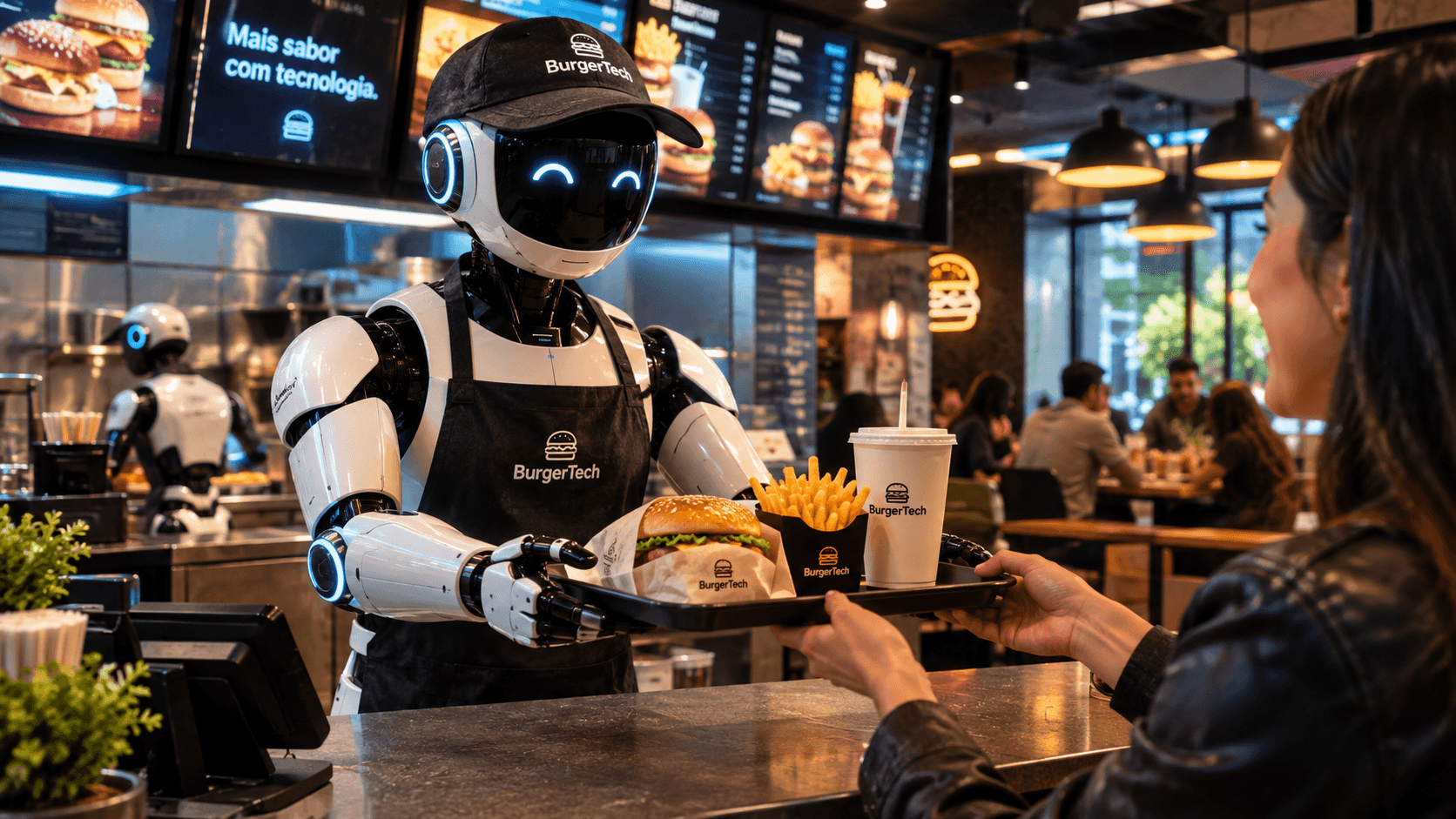
Imagine arriving at work to find your badge no longer opens the door. No one called you in for a conversation. A program added up your numbers for the month, compared them with your coworkers' and marked your name. The manager only found out afterward.
AI firing, decided by a system and merely communicated by people, is no longer a movie scene. On September 30, 2026, California placed limits on it by law. According to the state government, this is the first time this has happened in the country. The nickname of the main law says it all: the "robo boss" law.
This article shows, law by law, what is prohibited, what remains allowed and where the rule has holes. At the end, you see how this compares to a right that already exists in Brazil's data protection law.
Quick summary: the answer in 30 seconds. California passed four laws about AI in the workplace. Companies cannot punish or fire someone based solely on an automated system: a person must confirm. Mass layoffs caused by AI must be declared in writing. Using AI to guess an employee's emotion is prohibited. Monitoring bathrooms, with any technology, is also banned. The weak point is the word "solely": a human signature is enough.
Index
- What did California approve on September 30?
- AI firing: what is truly prohibited?
- What changes when AI causes mass layoffs?
- Can companies use AI to read your emotions?
- Where is the law weak?
- Why did California rush this now?
- In Brazil, can AI fire an employee?
- What this changes for you
- Frequently asked questions
What did California approve on September 30?
Governor Gavin Newsom signed 13 laws about artificial intelligence on the same day, and four of them address work. Together, they require human review in punishments and firings, force companies to declare when AI causes a mass cut and limit employee surveillance with AI.
The complete list is in the California government announcement, which also includes rules for healthcare, lawyers and fake images. The four that affect employment are in the table. SB indicates a bill that originated in the state Senate, and AB in the Assembly. The number is just identification.
| Law | What it does | When it takes effect |
|---|---|---|
| SB 947 | Prohibits punishing or firing based solely on automated system | July 1, 2027 |
| SB 951 | Requires declaring in notice when AI causes mass layoff | January 1, 2027 |
| AB 1883 | Prohibits AI that infers emotion or collects nervous system data | January 1, 2027 |
| AB 1331 | Prohibits monitoring employees in bathrooms | January 1, 2027 |
A note about the dates. SB 947 includes its date in the text itself. The other three include no specific date or request to take effect immediately, so they follow the state's general rule: a law passed in one year begins to take effect on January 1 of the following year.
"Robo boss" is not written in any of them. It is the nickname that unions and lawyers gave to SB 947, the No Robo Bosses Act. The president of the state labor federation, Lorena Gonzalez, called the set "four laws unprecedented in the country."
Newsom said in the announcement that AI should "expand opportunities, not grow at the expense of workers and families." If you want to follow the rest of this fight between governments and technology companies, our artificial intelligence page gathers the other chapters.
What is an automated decision system
All of SB 947 revolves around one term: automated decision system. It is any program that uses statistics or artificial intelligence to produce a simple result, such as a score, a list or a "yes or no," and that result helps or replaces a person's decision.
Think of a speed radar. It measures, compares with the limit and issues the fine without a guard having seen your car. At work, the equivalent is the program that counts deliveries per hour, screen time or calls answered and returns a team ranking.
A well-known example: delivery apps that disconnect the delivery person after their rating falls below a number. No one calls, no one asks what happened. The program sees the number but not the reason: the illness, the bereavement, the motorcycle defect.
AI firing: what is truly prohibited?
Starting July 1, 2027, companies in California cannot apply punishment or fire someone based solely on the result of an automated system. If the system is the main basis of the decision, a person must review and confirm, and the employee receives a written notice stating that the machine participated.
The official text of SB 947 has four parts worth knowing.
- Prohibition. The employer "may not rely solely" on an automated system to punish or fire.
- Human review. When the system is the main basis, the company must have a person confirm the decision, using the data the system used or other evidence.
- Notice afterward. The employee receives a separate communication, in plain language and in their preferred language. The text states that the system was used, that a human reviewed it, whom to contact in case of doubt and that there can be no retaliation.
- Access to data. The employee can request a "clear and objective" description of their own data that the system used.
The law also prohibits two specific uses. The company cannot use the system to infer employee characteristics that state law protects against discrimination, such as religion, disability or pregnancy. And it cannot use it to predict who will exercise a labor right and punish the person in advance.
There are two exceptions. Categories whose union negotiated, in the collective agreement, their own protection against algorithmic management and waived the rule in writing are excluded. And activities where a federal rule already governs the matter, such as aircraft manufacturing and defense products, are excluded.
The word that decides everything: "solely"
The law does not prohibit AI from participating in firing. It prohibits it from deciding alone. The system can continue building the ranking, pointing out the ten worst numbers and suggesting the cut. What changes is that someone in the flesh must look and confirm.
Another limit: the rule applies to punishment and firing. Hiring was left out. The program that reads resumes and discards candidates before any recruiter sees them falls outside this law.
In one sentence: California did not remove AI from the room where firing is decided, it only required that there be a person in there with it.
The complaint against Meta that haunts the law
Why did the state worry about this? Engadget, reporting on the signing, recalls a recent case. Former Meta employees, owner of Facebook and Instagram, accuse the company of using biased AI tools that allegedly chose "disproportionately" those who took medical leave for the cut list.
It is an accusation, not a conviction. But it shows the risk in simple terms. Someone who was away for two months due to illness produced less during those two months. A program that only looks at production will mark that person. A manager would know the reason, and American law prohibits punishing someone for medical leave.
What changes when AI causes mass layoffs?
Starting January 1, 2027, companies that make a large cut in California because of AI will have to say so in writing, in the notice that is already mandatory. The notice will now inform how many positions the technology replaced, what functions it will perform and what type of system it is.
The rule does not start from scratch. California already requires companies to give 60 days' notice before a mass layoff. SB 951 adds items to this notice when the cause is what the law calls technological displacement: the cut caused "in whole or in substantial part" by AI or other automation that takes over the positions.
Who falls under the rule, according to the text of SB 951:
- the workplace must have had 75 people or more in the last 12 months;
- the cut must affect 50 employees or more in 30 days.
To get an idea of the size: a bakery or small office never comes close to this. The rule catches factories, call centers and company headquarters.
This type of notice will have four new items, summarized by the labor law firm Fisher Phillips in an analysis published on JD Supra:
- the phrase "This notice is of a technological displacement" at the top of the page;
- the number of people laid off because of technology, with position and workplace;
- the functions these people performed that are now automated;
- the type of AI system or automation used.
The document goes to affected employees, to the state employment agency, to the local employment and training agency and to the chief elected official of the city and county. In practice, it becomes public information.
This is the point that most interests those who do not live there. Today, almost everything known about AI layoffs comes from executive statements in interviews. With the law, an official document begins to exist, with number of positions and name of technology. The same law orders the employment agency to deliver to legislators, by January 1, 2028, a report on AI's effect on hiring.
Can companies use AI to read your emotions?
In California, no longer. AB 1883 prohibits employers from using AI surveillance tools to recognize or infer an employee's emotional state, and also from collecting nervous system data, such as from headbands that measure attention. AB 1331 prohibits monitoring employees in bathrooms. The fine in both is up to 500 dollars per violation, an amount that weighs on a small company and little on a large one.
Here is another term to explain: emotion AI. These are programs that try to guess what a person feels from their face, tone of voice or typing style. It is like a lie detector turned on all day, without anyone having asked any question.
The best-known use is in call centers, with programs that rate the "empathy level" of the attendant's voice on each call. The rating can weigh on the evaluation of someone who was just hoarse, tired or has an accent the system knows poorly.
The text of AB 1883 goes a step further and bans the collection of "neural data," defined as information obtained by measuring nervous system activity. Few places use this type of device today. The law closed the door early.
There is a broad exception: the tool remains permitted when it serves "to ensure safety." A camera that detects drowsiness in a truck driver is the typical case. The law does not define where safety ends and surveillance begins, and this boundary should end up in courts.
AB 1331 is more direct. Except by court order, companies cannot use surveillance tools to monitor employees in bathrooms. The electronic bathroom door lock, opened with a badge, remains permitted, as long as it does not record sound or image and does not have embedded AI.
Where is the law weak?
The law has four weak points: the word "solely" allows a facade human review, the fine is small for large companies, it is the company itself that declares whether AI caused the cut, and the employee depends on the government to enforce the rule. None of them nullifies the law, but all reduce its reach.
The facade review. The law asks that a human confirm the decision. It does not say how much time they must spend or how many cases they can approve per hour. A manager who receives a list of 200 names and presses "confirm" on all of them complies with the letter of the text. This is our reading, and it is the most obvious criticism of any rule of this type.
The fine. It is up to 500 dollars per violation in SB 947 and in the two surveillance laws. For a small company, it weighs. For a company that saves millions by cutting a team, it is pocket change. The law also allows courts to order suspension of the practice, which tends to hurt more than the amount.
Who says it was AI? In the mass layoff notice, it is the employer who decides whether the cut was caused "in substantial part" by technology. And companies have already been fleeing this word.
The list of 2026 layoffs maintained by TechCrunch shows Monday.com, a task management software company, cutting about 600 people, 20% of the team, and stating that the decision "was not made to reduce costs or to replace people with AI."
The movement is broader. In June, TechCrunch noted that Robinhood, an American brokerage, laid off 10% of employees without mentioning AI once, after months when blaming technology was the fashionable explanation. If saying "it was AI" starts generating a public document, the incentive to say "it was restructuring" only increases.
Fisher Phillips lawyers also point out a technical hole: the law does not say what punishment the company receives for incorrectly filling out the new part of the notice.
Who enforces. In SB 947, enforcement falls to the state labor commissioner and public prosecutors. The text does not create a separate path for employees to sue the company based on it. Those who feel wronged file a complaint and wait for the agency to act.
In one sentence: the law requires the company to put a person and a paper in the middle of the decision, but does not guarantee that the person truly looks or that the paper says everything.
Why did California rush this now?
Because data began showing pressure on a specific group, young people starting their careers, even without a wave of layoffs in the economy as a whole. The most technology-connected state in the United States preferred to create the rules before the problem grew. It was also the last day for signing laws by a governor leaving office in January.
Three recent measurements help explain. In all appears the expression AI exposure: a score given to each profession according to the number of its tasks that a program can already do. Programmer and translator have high scores. Nurse and plumber, low.
The first measurement is from the state itself. On June 25, California launched a dashboard that crosses unemployment insurance claims with each profession's exposure, updated every month. The initial result was lukewarm: no sign of large-scale AI layoffs in the state, but higher claims among college-educated people in exposed professions and in the San Francisco area.
The second is from the Dallas Fed, one of the country's regional central banks, published on September 22. With records from Texas universities, economists compared more and less exposed courses. In the more exposed ones, the chance of the graduate finding employment in the state within a year fell 1.7 percentage points. The first-year salary fell about 5% between 2021 and 2024, compared to less exposed courses.
Of every 100 graduates in the most exposed courses, such as computer science, almost two more are left without a position, compared to the least exposed, such as nursing. The study's limit is geographic: it only sees those who studied and work in Texas.
The third is the "Canaries" dashboard from Stanford's digital economy lab, made with payrolls from about 25,000 companies and updated on September 23. In the most exposed professions, employment of women aged 22 to 25 shrinks 4.5% per year since the launch of ChatGPT in November 2022. That of men the same age shrinks 2.5%.
In professions with little exposure, employment of the same young women grows 1.3% per year. The name comes from the canary that miners took into the mine, because it sensed gas before people. The authors warn that the dashboard measures coincidence, not cause.
And there is the other side. A report from Ramp, a corporate card company, and Revelio Labs, on labor market data, described by TechCrunch in June, tracked nearly 22,000 companies. In those that spend the most on AI, the workforce grew 10.2%, and entry-level positions grew 12%. The caveat is from the authors themselves: the sample leans toward technology companies that were already growing.
Four measurements, no single answer. This debate has an article of its own here on the site: AI and jobs: what the numbers say about the fear. For this text, the following suffices: California legislated with warning signs, not with a confirmed catastrophe.
In Brazil, can AI fire an employee?
It can participate in the decision, and there is no Brazilian law that directly prohibits this. But workers in Brazil have had, since 2020, a right similar to the Californian one: to request review of any decision made only by automated processing of their data. It is in article 20 of the LGPD, Brazil's General Data Protection Law.
The updated text of the LGPD says that a person can request review of decisions "made solely based on automated processing" that affect their interests, including those that define their professional profile. The company must explain, clearly, the criteria used, respecting trade secrets.
Notice the coincidence. The Brazilian law says "solely." The Californian one says "solely." Both have the same weak point: if a human participated, even lightly, the decision ceases to be only the machine's.
And the Brazilian one has an additional hole. The paragraph that addressed how this review would be done was vetoed in 2019. Today the article does not say that whoever reviews must be a person. In theory, the review of an automatic decision can be another automatic decision.
| Point | California (SB 947) | Brazil (LGPD, art. 20) |
|---|---|---|
| What it covers | Punishment and firing in employment | Any automated decision with personal data |
| Term that limits the rule | "Solely" | "Solely" |
| Human in decision | Mandatory before punishing or firing | Not required by text |
| Who acts first | The company, which must notify the employee | The data owner, who must request review |
| Notice to worker | Mandatory, in writing | Only explanations, if the person requests |
| When it takes effect | July 1, 2027 | In effect |
The biggest difference is in the "who acts first" line. In California, the company must tell the employee it used the machine. In Brazil, the employee must suspect, request and insist.
There is another fundamental difference. In Brazil, companies can fire without just cause, paying severance, such as prior notice and the FGTS fine, a mandatory savings fund. They do not need to present a reason. Therefore, the LGPD helps more in situations where the automatic decision leaves a trail: blocking in delivery or transport apps, performance rating, warning, bonus cut.
What this changes for you
For those working in Brazil, the California law changes nothing immediately. It serves as a model of what may come and as a reminder of a right that already exists. Those working for American companies or managing teams have more things to observe.
| Your case | What changes | What to do |
|---|---|---|
| Employee in Brazil | Nothing in law. LGPD article 20 already applies | If you receive punishment or blocking that seems automatic, request the criteria and review in writing |
| Delivery person or app driver | Nothing in law. This is the case where the LGPD most applies | Save app messages and request review through the company's privacy channel |
| Brazilian hired by California company | Depends on contract. The law protects those employed in the state | Check whether you are an employee or service provider. Outside providers tend not to be covered |
| Manager or HR | Companies with California operations will have to map where AI enters punishments and cuts | Make the same map in Brazil: which systems give scores, who checks, what is recorded |
| Those starting careers | The law does not create positions | Combine knowledge of your field with safe AI use, which experts point out as rare |
About the last line: Professor Georgios Petropoulos, in an article in MIT Technology Review, argues that what is rare today is not knowing how to use AI, but combining that with mastery of a field.
If you are a manager, advice from someone who read the four laws: human review only protects someone when the reviewer has time, data and autonomy to disagree with the machine. Without the three, it is a rubber stamp.
Frequently asked questions
Can AI fire employees in California?
Alone, no, starting July 1, 2027. SB 947 prohibits punishing or firing based solely on an automated system. AI can continue suggesting names, as long as a person reviews and confirms the decision. The employee receives written notice stating that the system was used.
What is the "robo boss" law?
It is the nickname of SB 947, one of four labor laws about AI signed by Governor Gavin Newsom on September 30, 2026. The name comes from No Robo Bosses. It does not appear in the official text, which is simply called "Employment: automated decision systems."
When do California's laws about AI in the workplace take effect?
The mass layoff notice due to AI (SB 951) and the two surveillance laws (AB 1883 and AB 1331) take effect on January 1, 2027. The prohibition on punishing or firing based solely on an automated system (SB 947) begins on July 1, 2027.
Can companies monitor employees with AI?
They can, with limits. In California, using AI to infer employee emotion, collecting nervous system data and surveillance in bathrooms are prohibited. Cameras, time clocks and computer monitoring remain permitted. Tools used for safety are an express exception in the law.
What is automated decision making in the LGPD?
It is a decision made solely by automated processing of personal data, without human participation. Article 20 of the LGPD, Brazil's data protection law, gives anyone the right to request review of this decision and to receive clear explanations about the criteria used. It applies to credit, consumption and also to professional profile.
Do these laws apply to Brazilians?
Not directly. They protect those who work as employees in California. For those in Brazil, the reference is the LGPD. The indirect effect may come from global companies: when a rule forces headquarters to change an evaluation system, the change usually reaches subsidiaries.
To close
California did not prohibit the machine from opining on who stays and who goes. It required a person responsible for the decision and a document that tells the truth about the cut. It is little compared to the fear, and it is more than existed. The next test comes in 2027, when the first "technological displacement" notices are published and it becomes possible to count how many companies admit it was AI.





