
AI and jobs: what the numbers say about the fear
Recent graduates face a tougher job market in the U.S., but studies disagree on whether AI is to blame. See what the data shows and what to do for your career.
 NinaKalkazu.org
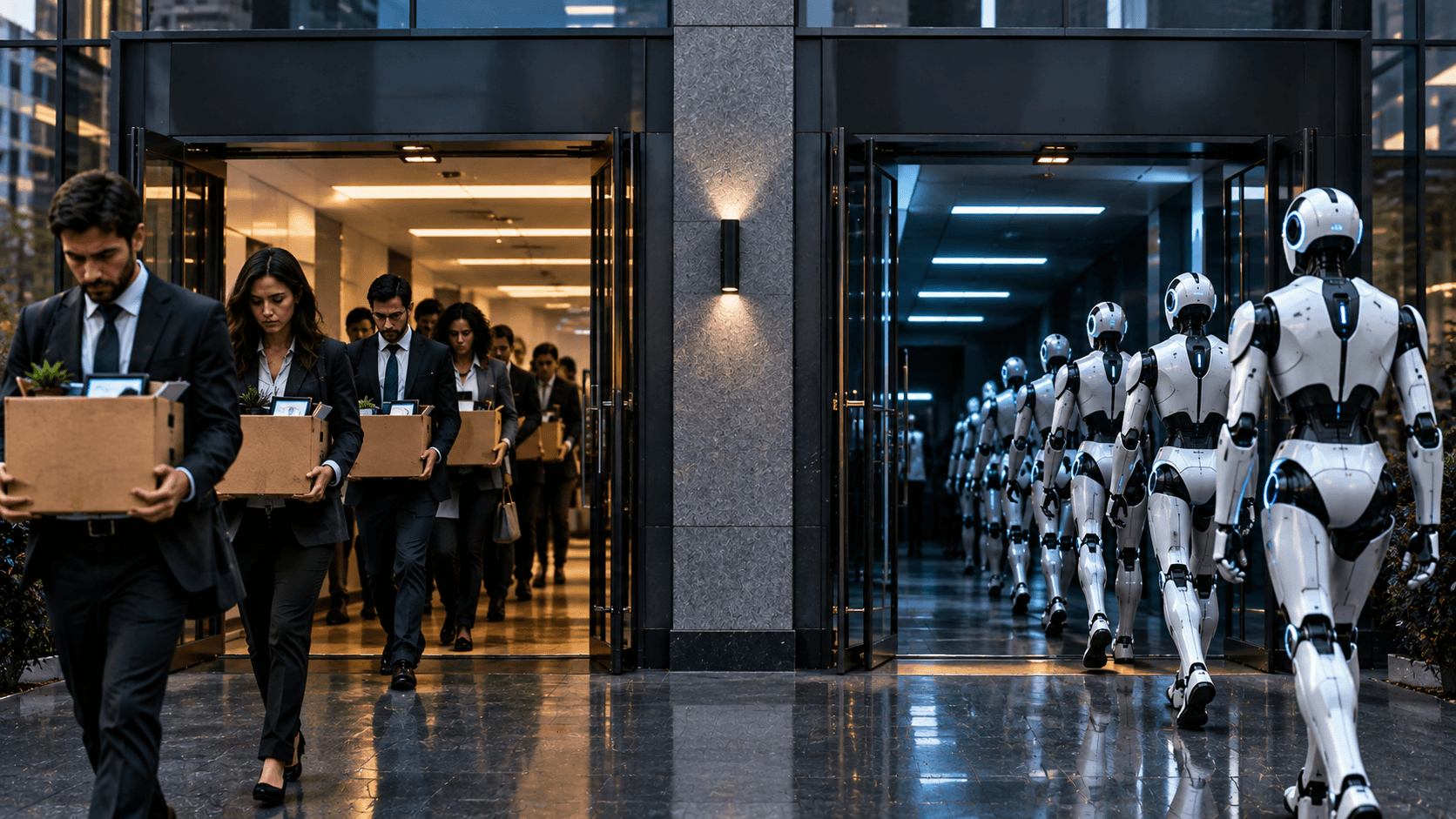
You graduate, send out a hundred résumés and hear back from almost none. On the other side, there may not even be a person reading: it could be a program. That's how many young Americans describe the search for their first job in 2026, and it's easy to point to a culprit.
The subject of AI and jobs has become a mix of numbers, guesswork and fear. There's official data showing that recent graduates are struggling more. There's a study saying artificial intelligence is to blame. And there's a study, with data from the same country, saying you can't make that claim.
This article separates what is numbers, what is guesswork and what is fear. You'll see what the numbers actually measure, why two serious studies disagree, where AI is already affecting paychecks (the case of lawyers is the clearest) and what makes sense for those starting their careers.
Quick summary: the answer in 30 seconds. In the United States, unemployment among recent graduates stands at about 5.6%, and 42% of them work in jobs that don't require a degree. A Stanford study sees fewer entry-level positions where AI does the work alone. Another, with government data, sees no jump in unemployment. Both may be right. And fear is running ahead: 74% of Americans who know about AI say AI worries them.
Index
- What do the numbers say about recent graduate unemployment?
- AI and jobs: is artificial intelligence really to blame?
- Will AI replace jobs or just tasks?
- How does AI enter candidate selection?
- Do those who use AI most also fear it?
- What's happening with AI in law?
- Who trains the beginner if entry-level positions disappear?
- What to do if you're starting your career?
- Frequently asked questions
What do the numbers say about recent graduate unemployment?
The official data comes from the Federal Reserve Bank of New York. In the second quarter of 2026, the unemployment rate for American recent graduates stood at about 5.6%. The underemployment rate, which counts graduates in jobs that don't require a degree, reached 42%.
First, who's counted. The New York Fed's panel on recent graduates defines recent graduates as those aged 22 to 27 with at least a bachelor's degree. The data covers the entire country, not just New York, and is released every three months.
Now, the size of the number. A rate of 5.6% means that out of every 100 young graduates who want to work, nearly six are looking and can't find anything. It seems small. The real discomfort is something else: a degree has always been seen as protection against unemployment, and the bank itself describes the market as "challenging" for this group.
Some news reports cite 5.7%. We checked the Fed's page on 10/02/2026, and the official text says "about 5.6%" for the quarter.
Unemployment and underemployment aren't the same thing
Unemployed is someone looking for work who can't find it. Underemployed is someone who has work, but below their training level. The Fed uses a simple measure: it counts as underemployed a graduate who occupies a position that normally doesn't require a degree.
Think of someone with a commercial driver's license who can only get work as a bicycle delivery person. They're working, but what they studied isn't being used. That's the case for 42 out of every 100 American recent graduates, according to the panel.
In one sentence: American recent graduates are having more difficulty than normal, and the bigger problem isn't being without a job, it's not getting a job in their field.
This shows something is wrong. It doesn't show the reason. That's where artificial intelligence enters the conversation.
AI and jobs: is artificial intelligence really to blame?
Nobody knows for sure, and the two best studies from 2026 reach different answers. Stanford researchers see a sharp drop in youth employment in professions most affected by AI. Economists linked to the German CESifo institute look at unemployment among these young people and find nothing out of the ordinary.
Before the studies, a term that appears in all of them: AI exposure. It's a score that economists give to each profession, according to how many of its tasks an AI program can already do.
It works like looking at a job's to-do list and marking with a pen what the machine does. The telemarketing attendant gets almost everything marked. The plumber, almost nothing. A heavily marked profession is an "exposed" profession. That doesn't mean it will disappear, just that the effect should appear there first.
The Stanford study: fewer entry-level positions
The study from Stanford's digital economy lab, revised in August 2026, uses payroll data from millions of American workers, with data through June. The main finding: employment of young people aged 22 to 25 in exposed professions is 19% below expected. In simple terms: if these professions had followed the pace of less exposed ones, there would be 100 young people employed where today there are 81.
Three details change how to read this number.
The first: the authors found no job losses in the economy as a whole. The effect appears only in the youngest workers. Experienced workers in the same professions show no similar difference.
The second: the difference comes from less hiring, not more firing. Companies aren't laying off beginners. They're not opening positions for them. The salaries of those employed have barely changed.
The third: the gap has been growing since the first version of the study, from August 2025. Ars Technica, covering the revision, highlighted this point: the trend hasn't stopped.
The authors themselves urge caution. They write that the results are early signals, not proof of cause. The study's title speaks of "canaries in the coal mine": the bird that miners took to warn of dangerous gas before anyone felt it.
The study that says the opposite
The paper published by CESifo, by economists Robert Fairlie and Jane Wu, uses another database: the monthly survey the U.S. government conducts in people's homes. They looked at June, July and August 2026, the months when new graduates enter the market.
The conclusion: unemployment among recent graduates didn't spike in the American summer of 2026 compared to previous summers. It also didn't rise significantly when compared to older graduates or to young people without degrees.
The authors also tested a broader calculation, including those who say they want a job but have given up looking. That adds almost two points to the rate. Even so, no unusual spike appeared in 2026.
As Ars Technica summarized in its report on this second study, it was the year many people expected to see damage, and the unemployment data showed no damage at all.
Why both can be right
The two studies measure different things. Stanford counts filled positions in each profession. CESifo counts people without work. Positions in an area can shrink without unemployment rising, as long as young people find something else.
| Stanford study | CESifo study | |
|---|---|---|
| Data source | Company payroll | Government household survey |
| What it measures | How many young people are employed in each profession | How many young graduates are without work |
| Who is analyzed | Young people aged 22 to 25 | Recent college graduates |
| Result | Employment 19% below in exposed professions | No unusual spike in 2026 |
| What it can't see | Where those who didn't enter the profession went | Whether the young person works in their field of study |
Go back to the underemployment number. If the young person who wanted to be a programmer can't find a position and goes to work in a store, they disappear from the exposed profession (Stanford sees it) and don't become unemployed (CESifo doesn't see it). The 42% underemployed fit perfectly in this space between the two studies.
There's also a second explanation, which has nothing to do with technology. The MIT Technology Review, in a report confronting panic with data, notes that American companies are going through a phase of little firing and little hiring. Those inside stay. Those outside wait. This hurts beginners with or without AI.
In one sentence: there are signs that AI is closing entry doors in some professions, but there's still no proof that it's the main cause of the squeeze on recent graduates.
Will AI replace jobs or just tasks?
So far, the data shows AI replacing tasks, not entire professions. The Stanford study found employment decline where AI is used to do the work alone. Where it's used as a helper for workers, employment remained stable or grew, especially for the more experienced.
The researchers name the two situations. Automating is the machine doing the task from start to finish. Complementing is the machine helping the person do better or faster.
The difference is the same as between a washing machine and a power drill. The washing machine does the entire job and you go take care of something else. The drill does nothing without someone holding it, but whoever holds it works much faster than with a nail and hammer.
A profession is a package of tasks. In some, almost everything is the washing machine type: answering the same questions, checking entries, writing simple code. In others, AI is a drill. It's in the former that entry-level positions shrink.
This helps explain why young people feel it first. Beginners typically receive precisely the repetitive part of the package. The experienced person keeps the judgment: deciding what to do, negotiating, taking responsibility when things go wrong. If the repetitive part goes to the machine, there's less reason to hire someone just for it.
A counterweight is worth noting. The Stanford study itself warns that part of the difference already appeared before generative AI (the kind that writes text and code, like ChatGPT) and decreases when education level is taken into account. Anyone selling certainty on this subject, one way or the other, is going beyond what the data allows.
How does AI enter candidate selection?
It enters from both sides. Some companies use programs to score and rank résumés before a person reads them. Candidates, knowing or imagining this, use AI to write their résumé the way they think the program wants. The result is a robot-versus-robot contest that doesn't improve anyone's life.
The technical term here is ATS, short for applicant tracking system. It's the program where the company receives applications, organizes them and tracks each person until hiring.
Think of emergency room triage. Someone receives everyone at the door, takes down information and decides the order of care. The ATS is that reception. In some companies, reception just organizes the line. In others, an AI feature inside it scores each résumé and puts the "best" ones first.
A Wired report on AI use on both sides of hiring shows what few people know: this varies widely. The reporter heard from dozens of recruiters. Some admitted using automatic ranking. Some guaranteed that people read all applications. According to her, the difference doesn't depend on company size, but on each one's culture.
The candidate has no way of knowing which case they're in. So they assume the worst and optimize their résumé with AI. Companies then receive hundreds of nearly identical applications and, to separate any, resort to automatic scoring. More AI on one side pulls more AI from the other.
Is it worth paying to "beat the robot"?
It's a bad bet. Tools that promise to adjust your résumé to the program's taste assume every company filters by AI, and the Wired report shows that's not true. The rule changes from company to company, and no outsider knows it.
The advice recruiters gave the magazine is old. Research less obvious companies. Write a cover letter, which almost no one sends anymore. Look for people, not just forms. In a selection process full of machine-made text, what stands out is what seems to have been made by people.
So far, we've talked about what's happening with positions. We still need to see what people feel, and one survey measured this country by country.
Do those who use AI most also fear it?
They do, quite a bit. A Gallup survey in 37 countries showed that 74% of Americans who know about AI say they feel concern about it. Among those who use it every day, it's 68%. Heavy use reduces fear, but only slightly. The survey measures the size of concern, not its reason.
The Gallup survey, done in partnership with Microsoft, heard from about a thousand people per country between April and July 2026. It asks about use, trust, expectation and emotion. The United States emerges as the most worried country on the list.
| In the United States | Say they feel concern about AI |
|---|---|
| Those who use AI every day | 68% |
| Those who use it less frequently | 80% |
| Those who never used it | 74% |
The 74% of those who never used it equals the country's overall figure by coincidence. Notice the middle line. The most worried group isn't those who never touched the tool, it's those who use it occasionally. Gallup warns you can't know what comes first: whether the person uses it more because they have less fear or loses fear because they use it more.
TechCrunch saw the glass half empty: even among those who open the app every day, two out of three are worried. The companies' promise was that contact with the technology would bring acceptance. It didn't.
The contrast with other countries is large. Only 36% of Americans think AI will help the country more than harm it. In China, it's 93%. In Singapore, where 46% use AI daily, it's 77%. Overall, concern is much lower: in the country right in the middle of the list of 37, only 32% of people say they feel it.
There's one more piece of data that helps understand Americans. Only 45% of those who use AI every day trust its answers a lot. Among those who never used it, 8%. The person uses it, finds it useful and remains suspicious. You can be curious and worried at the same time.
Since the survey doesn't ask the reason, linking this fear to employment would be our guess. What can be said is that fear is running ahead of the numbers: the American economy still shows no general job loss from AI, and three out of four people are already worried. If the topic of risks interests you, it's worth reading why the heads of major AI companies talk about slowing down the technology.
What's happening with AI in law?
Law firms are experiencing the clearest example of AI affecting money before affecting positions. Lawyers charge by the hour. AI does in minutes what took hours. The client notices and asks to pay less. Nobody was fired, but the firm's books don't balance like before.
The term here is billable hour: each hour the lawyer works on your case becomes a line on the invoice. It's like a taxi meter. The longer the ride takes, the more the driver earns.
A made-up example, just to see the math. A firm charges $500 per hour, and reviewing a stack of contracts took 10 hours: $5,000. With AI, the review takes 3 hours. By the meter, the bill drops to $1,500. The firm became more efficient and started earning less for the same service.
The firm can try to maintain the old price. Except the client also knows AI exists. A Thomson Reuters Institute survey of 2,527 lawyers and 116 firm leaders, published in August 2026, records the shift: a year ago, some clients asked the firm not to use AI. Now they ask it to show how it uses it.
According to the survey, when this conversation happens, clients ask for lower fees, as well as speed and transparency. A company's general counsel, heard by the researchers, asked the question that sums up the distrust. Is the efficiency gain reaching him? Or is the firm compensating by charging more for partners' hours, who are the lawyers who own the firm?
The pressure is real, and the outcome is still open. The same report shows that most lawyers surveyed barely talk about AI with clients. The solution discussed in the sector is to swap the meter for a flat rate: charge for the service delivered, not the time spent.
Will lawyers lose their jobs?
The most recent numbers don't show that. The American association that tracks law graduate placement, NALP, recorded that 93.4% of the class of 2024 was employed ten months after graduation. It's the highest rate in the series. In 2013, after the financial crisis, it was 84.5%.
The MIT Technology Review heard from young lawyers about actual tool use. They use AI to read stacks of documents and assemble drafts. For new or ambiguous questions, they report wrong answers and invented court decisions. In law, a mistake like that costs dearly, and the client wants a human responsible.
There's a warning sign. NALP itself warns that large firms reduced intern hiring and that upcoming classes should find fewer positions at these firms. The association doesn't link this to AI. And the 93.4% figure is for those who graduated in 2024, before the most recent tools.
In one sentence: in law, AI hasn't yet taken almost anyone's job, but it has already challenged the way of charging.
Who trains the beginner if entry-level positions disappear?
Today, nobody has that answer. The beginner's repetitive work has always had two functions: deliver the service and teach the profession. If the machine keeps the service, the company saves today and may be without trained people ten years from now.
A law firm intern learns by reading contract after contract. A junior programmer learns by fixing small bugs. A new analyst learns which numbers deserve trust. It's boring, and that's how the judgment that later becomes valuable is formed.
An opinion piece published in MIT Technology Review, by Professor Georgios Petropoulos of the University of Southern California, sums up the risk. The experienced professional of 2036, the one who will supervise AI, comes from today's class of beginners. A company that cuts this class cuts its own succession pipeline.
A young lawyer told the same magazine the feeling from the inside. He uses AI to search through contracts he used to read by hand and doesn't want to go back. But he wonders what he's failing to learn by not doing the repetitions that older lawyers did.
Here's our opinion: we think this is the most serious risk of the entire topic, precisely because it doesn't appear in any 2026 statistics. Unemployment is measured every month. A generation that didn't learn the craft is only noticed much later.
What to do if you're starting your career?
There's no guaranteed recipe, and the data above is from the United States. We didn't find, in the sources for this article, any equivalent measurement for Brazil. What can be taken away are lessons that apply anywhere: knowing how to use AI has become the minimum, and what differentiates is knowing a subject deeply.
Petropoulos's text has the most useful sentence about this: the young person's competition isn't against the machine, it's against the colleague who uses the machine. Knowing how to use AI without understanding anything yields little. Understanding a lot about something and ignoring AI also yields little. Rare is the person who combines both.
| If you are… | What the data suggests | A possible step |
|---|---|---|
| Student choosing a course | Entry-level positions shrink where work is repetitive and easy to describe step by step | Prefer programs with real practice: internship, project, service |
| Recent graduate looking for a position | Some companies filter by program, some don't, and there's no way to know which | Fewer mass applications, more direct contact and letters written by you |
| Beginner already employed | The repetitive part of your job is the easiest to automate | Ask for tasks requiring decisions and learn to check what AI delivers |
| Experienced professional | Where AI helps instead of replacing, employment held steady or grew | Use the tool and teach younger workers: the succession pipeline is your interest |
A practical caution: checking what AI delivers is a real skill. The lawyers heard by MIT Technology Review only use the tools because they know how to recognize when the answer is wrong. Those who don't master the subject have no way to notice.
If you want to better understand the tools before deciding how to use them, our page about artificial intelligence gathers the site's guides in simple language.
Frequently asked questions
Will AI replace jobs in the short term?
The 2026 data doesn't show general job loss in the United States. What appears is a drop in entry-level positions in professions where AI does the task alone, measured by Stanford. Experienced workers in the same areas weren't affected in the same way.
Is recent graduate unemployment caused by AI?
There's no proof. The rate stands at about 5.6% in the United States, according to the New York Fed, but a study with government data found no unusual spike in 2026. American companies are also going through a phase of little hiring, which hurts newcomers.
How does AI work in candidate selection?
Some companies use an AI feature within the application system to score and rank résumés. Others keep people reading everything. The candidate has no way of knowing which is the case, and that's why tools that promise to "beat the robot" are a gamble.
Why is fear of artificial intelligence so high in the United States?
The Gallup survey shows the size of fear, not the reason: 74% of Americans who know about AI say they feel concern, the highest rate among 37 countries. Only 36% think it will help the country. In China, it's 93%.
Will AI in law eliminate lawyers?
The numbers don't indicate that. The law class of 2024 had 93.4% employed ten months after graduation, a record. What changes first is billing: since AI shortens work, clients ask for lower fees from those who charge by the hour.
Does this data apply to Brazil?
All the numbers in this article are from the United States or Gallup's international survey. We didn't find, in the consulted sources, equivalent measurement for Brazil's market. The reasoning about repetitive tasks and entry-level positions serves as a warning, not a prediction.
The fear around AI and work is greater than what the numbers show so far, and that doesn't make it foolish. The most serious signal is at the entry door of professions. If you're starting out, the best use of your time is to learn a real craft and use AI within it.





