DHS Ban on DeepSeek: Ground Zero for AI Balkanization
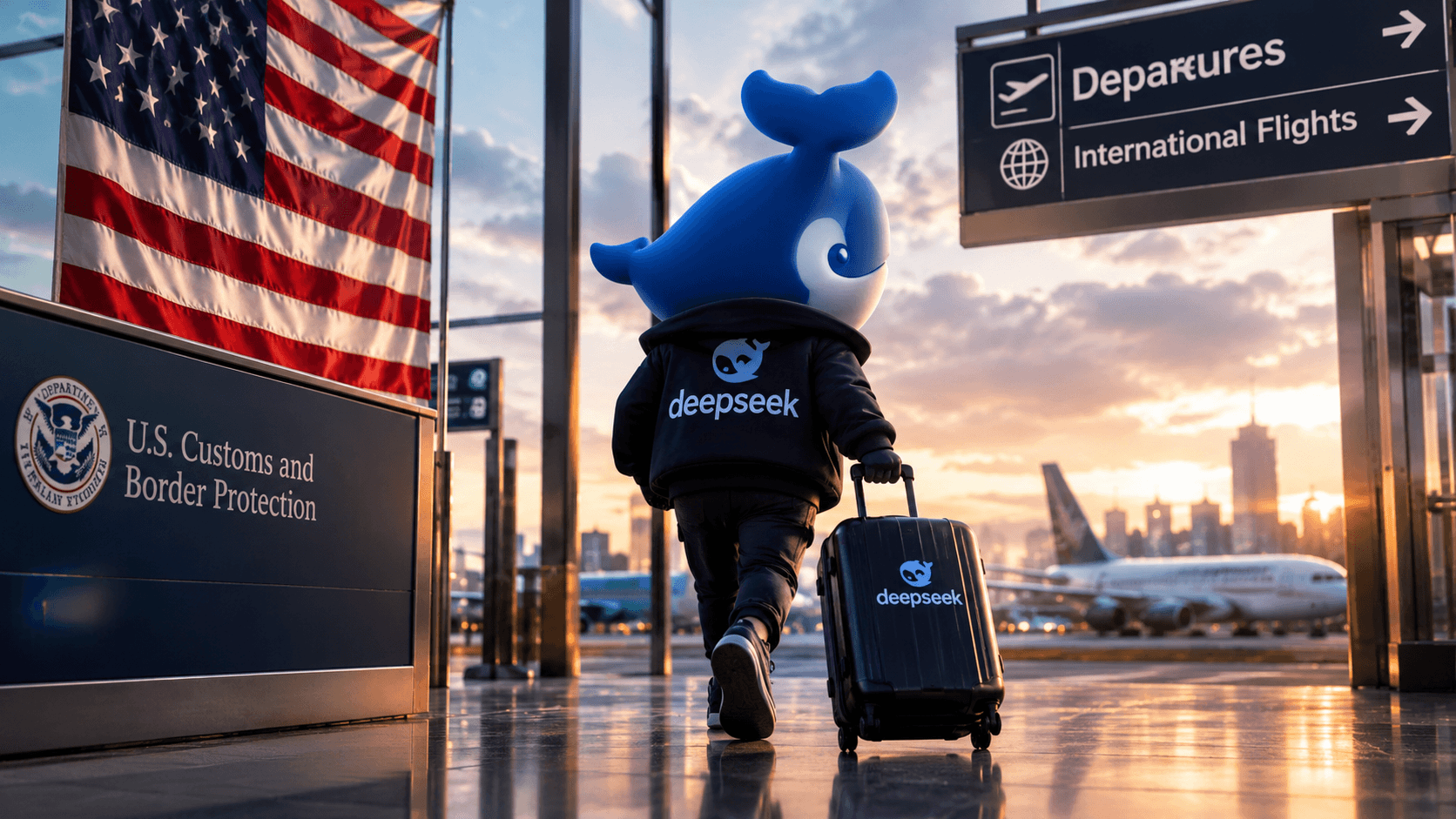
On October 19, 2026, the U.S. Department of Homeland Security issued an emergency order formally published in the Federal Register banning DeepSeek technologies from federal systems.
 NinaKalkazu.org
Listen to this article
Narrated by Thalita
1. Introduction: The Geopolitical Earthquake of the DHS Directive
On October 19, 2026, the U.S. Department of Homeland Security (DHS) issued an emergency order—formally published in the Federal Register on October 20—mandating the immediate removal and compulsory prohibition of acquisition of all technologies developed by Chinese startup DeepSeek from civilian federal executive information networks. The determination marks a decisive turning point in global technology governance, cybersecurity, and artificial intelligence (AI) regulation.
This measure signals the historic transition from isolated, targeted restrictions—such as the bans decreed by the U.S. Navy in January 2025 and the Department of Commerce in March 2025—to a systemic purge of the government's software supply chain. The DHS action demonstrates that technological rivalry between superpowers has transcended benchmark performance metrics and raw algorithmic capability, shifting the center of the dispute to the deep infrastructure of software.
The fundamental analytical premise of this move is that the global AI confrontation has entered the structural audit phase. International competition is no longer defined solely by the race for models at the technological frontier, but rather by data sovereignty, supply chain integrity, and the irreversible division (balkanization) of the global digital ecosystem into rival geopolitical blocs.
2. The Legal Context and Comprehensive Scope of the Directive (2018 FASA)
The legal foundation of the DHS executive order is based on the Federal Acquisition Supply Chain Security Act (FASA) of 2018. The legislation grants authority to the federal government to manage and mitigate risks in the information and communications technology supply chain, authorizing the exclusion and compulsory removal of products or suppliers that pose a threat to national security in government IT systems.
The most drastic aspect of the DHS directive lies in its extended reach to third parties (Third-Party Ban). The prohibition is not limited to direct DeepSeek applications or services; it expressly bans any commercial tools, APIs, integrations, or software developed by private companies that incorporate the foundation models, weights, or code architectures of the Chinese startup. This requirement imposes severe operational responsibility on private IT suppliers to the U.S. government, who are now obligated to conduct rigorous audits on the software provenance of their own technology stacks.
Strict enforcement mechanisms have been established: civilian agencies and their service providers must immediately halt new acquisitions and proceed with removal from existing systems. A strict 60-day window is granted for agencies to submit requests for exceptions or compliance deferrals. However, the granting of exemptions is strictly restricted to scenarios where immediate removal would directly jeopardize the continuity of critical public operations.
Operational Pillars of the DHS Executive Order
Procurement Prohibition: Immediate block on new acquisitions of licenses, services, contracts, or direct and third-party APIs linked to DeepSeek.
IT Purges: Compulsory removal of all existing instances of models, code, and applications based on DeepSeek from federal civilian networks.
Third-Party Verification: Mandatory deep audit of the software supply chain for private suppliers, ensuring freedom from components derived from the Chinese company's architecture or weights.
3. Risk Vectors and National Security Justifications
The coordinated action by the U.S. government integrates opinions from the White House, DHS, the National Security Agency (NSA), the Cybersecurity and Infrastructure Security Agency (CISA), the FBI, and the Department of the Treasury, consolidating technical and legal arguments about the threat faced.
In the realm of privacy and data sovereignty, a memorandum signed by Secretary of Homeland Security Markwayne Mullin in July 2026—and made public with the October 19 order—highlighted that DeepSeek's account creation process collects Personally Identifiable Information (PII) and performs continuous user tracking and fingerprinting. DHS formally warned that the transmission of telemetry, prompts, and responses to servers located in China enables the compilation of actionable intelligence on U.S. citizens and government programs.
This concern is corroborated by international precedents of privacy violations. South Korea's Personal Information Protection Commission (PIPC) confirmed in an official investigation that personal data and prompts from more than 1 million South Korean users were transferred to China without consent. The structural risk is intensified by the legal framework of the People's Republic of China (PRC): the National Intelligence Law (with the 2018 amendment) imposes state jurisdictional coercion, obligating Chinese companies and citizens to cooperate unreservedly with state intelligence services and to cede access to data or infrastructure on demand.
In terms of cyber vulnerabilities, technical security analyses identified critical flaws in DeepSeek's iOS mobile application, pointing to risks of malware embedding, in addition to repeated and systematic failures in guardrail tests against prompt injection and jailbreak attacks.
The escalation of the ban was also driven by accusations of "illicit distillation" (distillation attacks). Documented by the White House's National Security Memorandum NSTM-4 and by alerts from the FBI, NSA, and CISA, investigations indicate that Chinese companies conducted automated campaigns on an industrial scale to extract intelligence from cutting-edge American models. Anthropic reports detail that Chinese entities created more than 24,000 fake accounts and executed more than 16 million automated interactions to copy the capabilities of the Claude model, cheapening their R&D costs by hundreds of millions of dollars. Treasury Secretary Scott Bessent and the White House classified the practice as industrial espionage and intellectual property theft, signaling financial sanctions and the inclusion of the companies involved on the Department of Commerce's Entity List.
Identified Risk Vector | Mechanism / Origin of Risk | Practical Implications for Government IT |
PII and Telemetry Transfer | Data collection during registration, user tracking and fingerprinting (South Korean PIPC precedent: >1 million affected). | Exposure of sensitive data from public servants and generation of intelligence on government operations. |
State Jurisdictional Coercion | China's National Intelligence Law (2018 Amendment). | Compulsory access by the Chinese state to conversation histories, operational prompts, and authentication keys. |
Code Vulnerabilities and Malware | Critical security flaws in iOS application and continuous guardrail failures. | Risk of cyber invasion, lateral movement, and compromise of critical civilian networks. |
Illicit Distillation Attacks | Industrial extraction of U.S. model capabilities (Anthropic: >24,000 fake accounts and >16 million interactions). | Unauthorized absorption of Western intellectual property and circumvention of real R&D costs. |
Supply Chain Integrity | Inclusion of DeepSeek open-weights or code in government supplier software. | Need for software provenance auditability and deep stack inspection by private contractors. |
4. DeepSeek's Technological Trajectory: Algorithmic Efficiency vs. Hardware Sanctions
The rapid evolution of DeepSeek's models—from R1 in January 2025, through V4 in April 2026, to the launch of DeepSeek-V4.1-Flash-1017 on October 17, 2026 (published just two days before the DHS order)—caused a strong impact on the sector. The startup's accelerated advancement challenged the Western paradigm focused on massive scaling of computational power.
Incentivized by semiconductor export controls imposed by Washington, DeepSeek invested in inference engineering and resource optimization. The adoption of the Mixture-of-Experts (MoE) architecture—which activates only specific subnetworks during inference—combined with transfer learning and a hybrid attention architecture with a 1 million token context window in V4, enabled reduced operational costs and mitigated hardware scarcity.
By making its models available under the free MIT license in open-weights mode, DeepSeek enabled global developers to download and adapt the technology locally. However, the technical metrics of the V4 model (with 1.6 trillion parameters) reveal that the distance from the U.S. technological frontier remains evident. DeepSeek's own documentation admits that V4 lags 3 to 6 months behind cutting-edge American models.
Model / AI System | License Type / Access | Parameters / Architecture | Relative Position at Technological Frontier |
GPT-5.5 / Gemini 3.1 Pro / Claude Opus 4.5 | Proprietary / Closed | Massive scale / U.S. Frontier | State-of-the-Art Leadership (U.S. ~7 months ahead) |
DeepSeek V4 Pro | Open-Weights (MIT License) | 1.6 Trillion / Hybrid MoE Architecture | 3 to 6 month lag behind American frontier |
DeepSeek-V4.1-Flash-1017 | Open-Weights (MIT License) | Optimized for fast inference | High-efficiency iteration (Trigger for Washington reaction) |
Despite advances in optimization, Chinese dependence on American hardware remains critical. U.S. government reports indicate that V4 training used smuggled Nvidia Blackwell chips in violation of sanctions. Under Beijing's guidance, DeepSeek began transitioning to domestic accelerators, stockpiling Huawei Ascend 910B chips and deploying CloudMatrix 384 systems, while Alibaba expanded the Qwen model family. Nevertheless, the lack of computational capacity prevents DeepSeek from serving V4 Pro at industrial scale to its global user base.
5. Geopolitical Implications: U.S.-China Rivalry, Pluralization, and the Race for Adoption
The confrontation around DeepSeek has redefined geopolitical competition. Analyses by the Council on Foreign Relations (CFR) indicate that the global dispute has unfolded on two fronts: the "Frontier Race" (development of raw cognitive capability) and the "Race for Adoption" (speed of technology deployment in the real economy).
Open, cheap models with "good enough" performance find strong penetration in the Global South. Presenting reduced infrastructure costs, DeepSeek models registered more downloads on the Hugging Face platform than their American competitors, transforming ease of diffusion into a primary vector of digital influence.
This scenario accelerated technology stack fragmentation, driven by three central factors:
Increased Sanctions and Commercial Exclusions: The intensification of restrictions by the U.S. Department of Commerce and the use of the Entity List forced the segregation of hardware architectures and software supply chains.
Bilateral Controls and Beijing Retaliation: Parallel to internal ideological alignment requirements, Chinese authorities proposed, in October 2026, an export control list covering 40 critical technologies (including AI, biotechnology, and solar energy), restricting the deployment of Chinese models abroad and demonstrating that balkanization is applied bilaterally.
The Quest for Strategic Autonomy and Pluralization: Intermediate nations seek alternatives to Washington and Beijing hegemony, fostering autonomous regional ecosystems.
This dynamic consolidated multiple development poles: Gulf countries are making massive investments in supercomputers and data centers; India seeks AI leadership in the Global South; and South Korea and Japan establish strategic positions in hardware, industrial automation, and robotics.
6. Strategic Autonomy and the Debate on Digital Sovereignty in Europe and the World
The containment promoted by the U.S. and the expansion of efficient Chinese models place the European Union before a strategic impasse. The bloc seeks to reconcile the application of strict ethical and privacy standards—anchored in GDPR, the 2024 AI Act, and the April 2025 AI Continent Action Plan—with the urgency of accelerating industrial adoption of artificial intelligence.
Analyses by the European Union Institute for Security Studies (EUISS) highlight a critical gap in European policy: although the AI Continent Action Plan invests in expanding supercomputing infrastructure, it neglects computational efficiency. This omission makes resource optimization engineering and the use of "good enough" models a key factor for the continent's industrial competitiveness.
For European productive sectors—such as factory automation, robotics, logistics, and the Internet of Things (IoT)—the adoption of large-scale proprietary models faces barriers due to high operational costs and rapid obsolescence cycles. The use of efficient smaller-scale models run locally (on-premise or edge) emerges as a viable alternative to strengthen European technological autonomy, preserving regulatory data protection standards without compromising private sector competitiveness.
7. Conclusion: The New Rules of the Game in AI Infrastructure
The ban determination issued by DHS in October 2026 establishes a definitive precedent for global technology governance. The measure demonstrates that risk management in artificial intelligence has migrated from the superficial layer of applications to the requirement of rigorous software provenance auditability, inspecting code origin, training data integrity, and the entire technology supply chain.
The DeepSeek case confirms that algorithmic efficiency is a powerful element in technological competition, but does not replace the requirements of legal compliance, cybersecurity, and sovereignty demanded by states.
In a multipolar and fragmented international ecosystem, the resilience of public and corporate infrastructures will depend on the continuous capacity for auditability of their digital dependencies, ensuring data protection and technological sovereignty across all layers of artificial intelligence.