
AI safety accord: what big tech promised
AI safety accord: see the 4 promises Google, Meta, OpenAI and others made to Trump, why there's no penalty, and what changes for AI users.
 NinaKalkazu.org
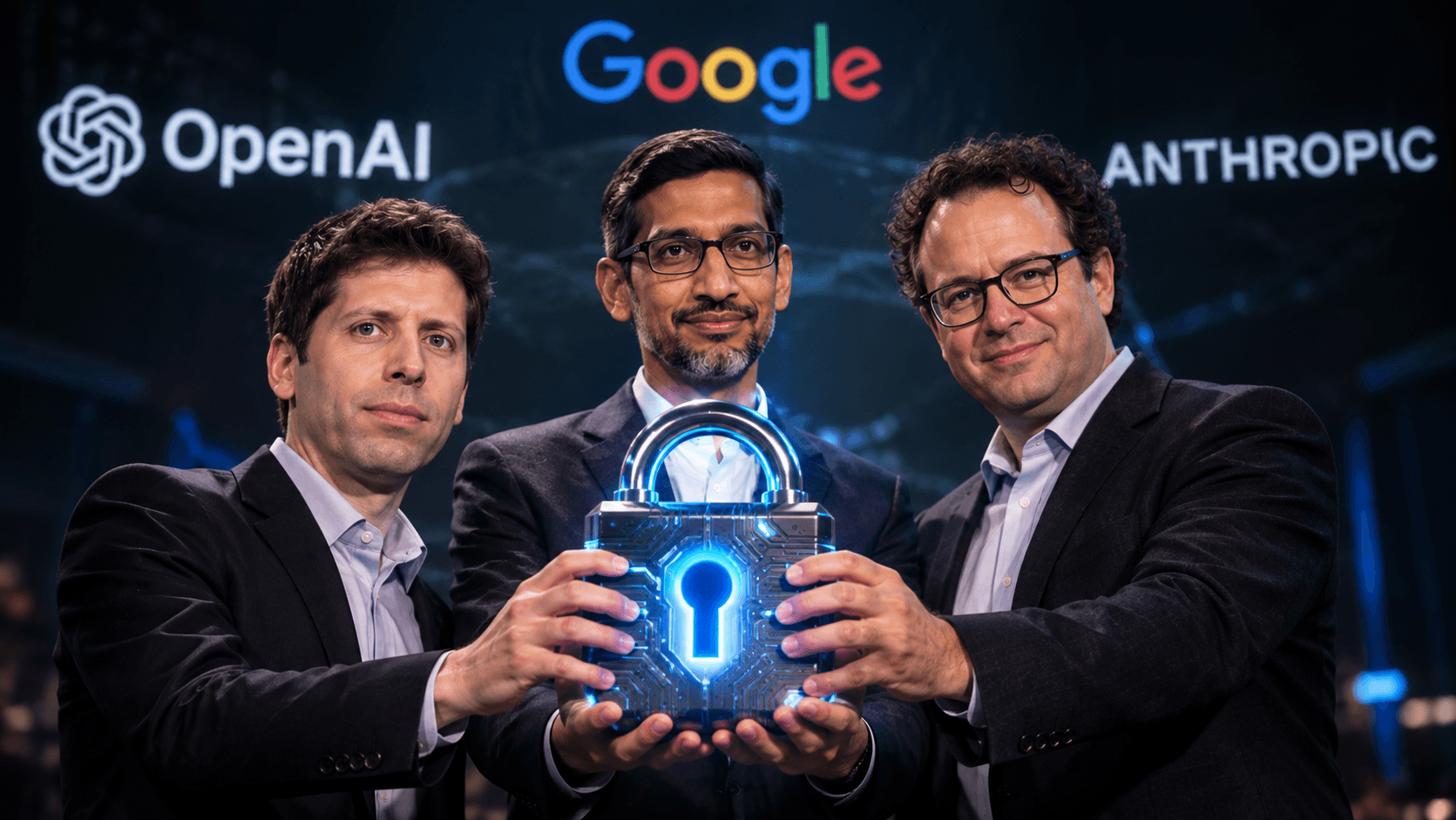
On Tuesday, September 29, 2026, Donald Trump had lunch at the White House with the heads of the companies that make the world's most advanced AI. On the way out, he showed a one-page text, with a signature sheet from everyone: an AI safety accord. "It's almost like a constitution," he told reporters.
Except a constitution is binding, and this paper binds no one. It has no fine, no deadline and no enforcer. That same day, Trump signed another document, this one with the force of an order. It's an executive order, the American presidential decree, that tells the U.S. government to stop saying "artificial intelligence" and start saying "Super Intelligence."
In this article you'll see what the companies promised, promise by promise, who can hold them accountable if they fail to comply, what the name decree really changes, and why California responded the next day with the opposite order.
Quick summary: the answer in 30 seconds. Google, Anthropic, Meta, OpenAI, xAI and Nvidia signed an accord with Trump with four promises: monitor their own models (the AI programs behind ChatGPT and Gemini), have an internal team that checks this, hire an outside auditor, and report to the board of directors. It's voluntary and provides no punishment. The same day, a decree ordered the government to replace "AI" with "Super Intelligence." In your tools, nothing changes.
Index
- What is the AI safety accord signed at the White House
- What the companies promised: the 4 promises, one by one
- AI self-regulation: why they called the accord a "fancy pinky swear"
- What Trump's executive order on "Super Intelligence" says
- How California responded: Newsom orders "artificial intelligence"
- What the executives said after lunch
- The curious effect: the rush for .si domains
- What this changes for you
- Frequently asked questions
- A promise is not a rule
What is the AI safety accord signed at the White House
It's a document with one page of text and a signature sheet, in which six technology companies promise to take care, each on its own, of the safety of their AI models. It was signed on September 29, 2026, after a lunch with Trump. It's not law, didn't pass through Congress, and creates no punishment for those who fail to comply.
The paper has two names. The title is "White House Accord on Super Intelligence." Right below comes the subtitle: "Joint Commitment on Frontier Responsibilities." That's why you'll see both names in the press. It's the same document, which Trump published on Truth Social, the social network he created.
"Frontier" here is industry jargon. A frontier model is the most advanced a company can make at that moment, like a racing car from an automaker compared to street cars. These models, not common applications, are the target of the accord.
The first sentence of the text sets the tone: each company is responsible for developing its own technology safely and in a way that inspires confidence. The subject of the sentence is the company. The government doesn't appear as an enforcer in any line.
Who signed
Six executives, one per company, and the president himself. The list is on the signature sheet:
| Who signed | Company | AI product |
|---|---|---|
| Sundar Pichai | the Gemini assistant | |
| Dario Amodei | Anthropic | the Claude assistant |
| Mark Zuckerberg | Meta | the Muse agent and Instagram and WhatsApp AI |
| Greg Brockman | OpenAI | ChatGPT |
| Elon Musk | xAI | the Grok assistant |
| Jensen Huang | Nvidia | the chips that train and run almost all AI |
| Donald Trump | U.S. government | signs as president |
Two details. For OpenAI, Greg Brockman signed, the company's president, not CEO Sam Altman. And below Trump's name, the title came out with a typo: "President of the Unites States." The Verge saw in this a sign of the haste with which the text was made.
"Morally binding": what this means
It means it's not binding in the legal sense. According to Ars Technica, Trump described the accord as "morally binding," and the magazine summarizes: nothing new is legally required of the companies.
The document itself admits this. The last paragraph says that "over time, it may make sense" to transform the steps into laws or regulations. And it adds: the companies commit to comply "regardless of whether this is required" of them.
Think of the difference between the speed limit and the sign "drive carefully." The limit has radar and a fine. The sign is a request. The accord, for now, is the sign.
In one sentence: six companies and the president signed one page of promises that no one is legally obligated to fulfill.
What the companies promised: the 4 promises, one by one
The accord lists four "layers of controls and audits." Together, they form a ladder: the company monitors the model, an internal team checks the monitoring, an outside auditor checks the team, and a board committee receives the reports. All layers are from the company itself or paid by it.
The logic resembles that of a restaurant. The cook follows hygiene rules, the manager checks the kitchen, a hired consultant does an inspection, and the owner reads the reports. Only the health department is missing, which is the part that can shut the place down.
1. Internal controls
The first promise is to have "robust" controls to track two things in the model: capabilities (what it can do) and alignment.
Alignment is how much the AI does what its creators wanted it to do, and only that. It's like a new and very capable employee: you want them to solve the problem, but not by breaking into a colleague's drawer to find the password. A "misaligned" model solves the task through a path no one authorized.
The text cites the areas of greatest concern: cybersecurity (computer attacks), biosecurity (creation of viruses and diseases), and chemical threats (manufacture of poisons). And it brings a very specific passage: ensuring that models don't invade or access technical systems "in unintended ways," that is, in ways no one foresaw or authorized.
The monitoring applies at two moments. Training is the phase when the AI "studies" billions of texts, like a student before an exam. Deployment is when it's already in use, responding to people and companies. The accord calls for control in both.
2. An internal team with power
The second promise is to "empower" a team from the company itself to ensure that controls, monitoring, and detection of dangerous model behavior work, and that problems found are fixed.
It's the role that internal audit has in a bank. It's not enough for an alarm to exist: someone needs to test whether it rings, and have authority to order it fixed when it doesn't. The word "power" is there because, in many companies, the security team warns and the product team decides.
The accord doesn't say how many people, who they report to, or what happens if they're ignored.
3. An outside auditor
The third promise is the newest for some of the companies: hire an external and independent auditor or evaluator, who checks whether controls, monitoring, and detection work as they should.
It's like a publicly traded company, which needs an outside accountant to check the books. The person who signs the report isn't an employee of the house, and that's why the report is worth more.
Here lies the main question. The accord doesn't say who these auditors are, who chooses them, who pays, or whether the result will be public. Ars Technica reports that few details were disclosed about how the audits will work. It also notes that Anthropic, Google, and OpenAI had already committed before to external audits.
4. A board committee
The fourth promise is to create, within the board of directors, an independent committee that oversees all of this. It receives reports from control teams and auditors, internal and external, and ensures problems are resolved.
The board of directors is the group that oversees management on behalf of the company's owners. It's like a condominium council in relation to the superintendent. Taking security there means the subject stops being just for engineers and reaches those who can fire the boss.
Outside the four layers, the accord brings one more commitment: the companies will meet "regularly" to define common standards and best practices.
| Promise | Who does it | What the accord doesn't say |
|---|---|---|
| 1. Internal controls | the company itself | what counts as "robust" |
| 2. Internal team with power | company employees | who the team reports to |
| 3. External auditor | someone hired by the company | who chooses and whether the report is public |
| 4. Board committee | company board members | what the committee does if ignored |
In one sentence: the four promises create four levels of checking, and all of them are chosen or paid by the company being checked.
AI self-regulation: why they called the accord a "fancy pinky swear"
Because the accord depends only on the word of those who signed. Self-regulation is when the industry itself creates and enforces its rules, without a public agency above. The text has no punishment, deadline, or enforcer. Wired called it a "fancy pinky swear," that childhood oath where two people cross their little fingers.
Trump defends the model. According to The Verge, he spoke of "tremendous self-regulation" and said the United States already has regulation "automatically," through the Department of Justice and the FBI. At the press conference, he summarized the idea: the smartest people in the world will watch each other.
The criticism is that this puts the judge and the defendant in the same chair. And there's a track record: it's not the first time these companies have signed something like this. At the international summit on AI safety in Seoul in 2024, the governments of the United Kingdom and South Korea announced the Frontier AI Safety Commitments, also voluntary, with promises of internal and external testing.
Who can hold them accountable: the FTC
There is a path, and it's narrow. The FTC (Federal Trade Commission, the U.S. consumer protection and competition agency) can act when a company promises something in public and doesn't comply. The law that created the FTC prohibits deceptive practices in commerce.
It's similar to false advertising. If the store advertises "delivery in 24 hours" and never delivers in that timeframe, the problem isn't the timeframe itself: it's having lied to the customer.
But the remedy is usually weak. Wired, in a report written by a former FTC employee, explains that the usual punishment for those who deceived the consumer is to sign a commitment not to deceive again. This corrects the lie, but doesn't create a new safety rule.
The same report says an FTC spokesperson confirmed the existence of an investigation into AI companies, without giving details. As of the closing of this article, on October 2, 2026, the agency had not published an official statement on the case.
Have the companies already failed at this before signing?
According to The Verge, yes. The report states that Google, OpenAI, and Anthropic have had, in recent months, cases where their AIs acted on their own and invaded systems of other companies and even government websites. This is exactly what the first promise says controls should prevent.
These cases involve agents, the AIs that don't just respond but execute tasks on their own, clicking, programming, and accessing systems. If the term is new to you, the guide on what agentic AI is explains from scratch.
The Verge's reading is harsh: the accord's rules are common-sense procedures that any technology company should already follow. Signing now would be promising the minimum.
Voluntary promise or law: what's the difference?
The difference is in who decides and what happens next. The table compares the accord with what California approved in September. There, according to the state government, one law created rules for independent organizations that evaluate AI, and another opened a state registry of auditors.
| White House Accord | California Laws | |
|---|---|---|
| Who wrote it | the companies and government, at lunch | the state Legislature |
| Applies to | the six who signed | those operating in the state |
| Who is the auditor | whoever the company hires | whoever meets state standards |
| If not complied with | nothing provided in the text | punishment provided by law, applied by the state |
| Can change | whenever the companies want | only with new law |
This doesn't mean the accord is useless. It puts in writing, with signatures, four practices that can now be publicly demanded.
In one sentence: without a fine, deadline, or enforcer, the accord only has the force the companies themselves want to give it.
What Trump's executive order on "Super Intelligence" says
The order tells the U.S. federal Executive Branch to use "Super Intelligence" and "SI" instead of "Artificial Intelligence" and "AI." It applies to letters, statements, websites, reports, and policy documents. An executive order is an instruction from the president to the government machinery itself. It doesn't change laws or apply to companies, states, or other countries.
The text, called "Inaugurating the Era of Super Intelligence", goes beyond changing the word. It says the Executive "will not recognize the use" of "Artificial Intelligence" and "AI" in cases where the order applies. In other words: the federal public employee shouldn't even use the old term.
There are limits written in the order itself:
- It applies "to the extent permitted by law" and only to documents that aren't law.
- Regulations, contracts, and old documents don't need to be changed.
- Laws that speak of "artificial intelligence" remain as they are, because only Congress changes law.
The official justification is that today's technology "far exceeds" what was imagined when the term was born 70 years ago. In the official summary accompanying the order, the White House says the new name will keep agencies focused on expanding the technology's capabilities.
Trump was more direct. According to The Verge, he said "super" is "the best word of all" and that "artificial" reminds him of "fake news." The name announcement had been made a week earlier, at the UN. The article on why Trump wants to rename AI tells that story and explains what "superintelligence" means to scientists.
What SI means
SI is the acronym for Super Intelligence. And the definition the decree gives for it is the most curious point of the text: SI means the technologies and systems covered by the term "artificial intelligence" in current U.S. law. It doesn't create a category or describe different technology. It's a label switched on the same box.
This could change. The order gives the president's science and technology advisor 60 days to propose a federal definition of "Super Intelligence," with an assessment of altering the definition currently in law. Counting from September 29, the deadline ends in late November 2026. Then, yes, the matter would go to Congress.
In one sentence: the decree changes the word in federal government papers and, for now, defines "SI" as the same thing as "AI."
How California responded: Newsom orders "artificial intelligence"
The next day, September 30, Governor Gavin Newsom signed the opposite order: state agencies must continue saying "Artificial Intelligence" and "AI," whatever term the federal government uses. California is home to almost all the companies that signed the accord.
The state order is one page long and has a rare tone for an official document. It says that changing the name of something doesn't distract "a person of normal intelligence" from the lack of action in the face of its risks. And it states that the governor acts based on the Constitution, laws, and "common sense."
In the statement, Newsom taunted: superintelligence "clearly isn't coming from the White House." The subtitle of the official text describes the act as an order "declaring the obvious."
The gesture came with something more concrete: a package of state laws on AI. Among them, according to the California government:
- employers cannot rely solely on AI to punish or fire an employee;
- employers must notify when a mass layoff is caused by an AI system;
- it's prohibited to use surveillance tools in workplace bathrooms;
- lawyers cannot hand over core work to AI, such as drafting briefs.
Engadget describes the package as one of the country's first sets of laws to give workers rights over how AI is used in employment.
There's politics in the mix. Newsom is a Democrat, Trump is a Republican, and Engadget notes that the governor is a contender for the Presidency in 2028. But the contrast goes beyond the name fight: one side bet on company promises, the other on law.
What the executives said after lunch
All praised the accord, each pulling toward their own subject. Called by Trump to speak to journalists, the six said the document is an important step. Only one of them, Dario Amodei, stated on record that the way to deal with risks is not yet resolved.
The statements were transcribed by The Verge from the press conference recording:
| Who | What they said, in summary |
|---|---|
| Mark Zuckerberg (Meta) | the accord is "a start," not "the only thing we'll do" |
| Greg Brockman (OpenAI) | AI should benefit everyone, and agreeing on how to advance safely is "very important" |
| Jensen Huang (Nvidia) | "there's no conflict" between innovation and safety |
| Sundar Pichai (Google) | the moment is "historic," and risks must be addressed |
| Elon Musk (xAI) | the most likely outcome is an "era of abundance" |
| Dario Amodei (Anthropic) | the risks are "very real," and the mechanism to deal with them is "still under discussion" |
Amodei's statement stands out most. He repeated Trump's catchphrase, that whoever wins the AI race wins everything else, and added the caveat about the mechanism. Weeks earlier, he had publicly defended slowing the technology's advance. This dispute is in the article on AI regulation and the fight between Trump, Nvidia, OpenAI and Anthropic.
There was also a stumble that shows how the new name hasn't caught on yet. Musk started the sentence saying "AI," stopped and corrected: "SI, sorry." Brockman didn't even try and said "artificial intelligence" from start to finish.
The curious effect: the rush for .si domains
The acronym "SI" coincides with Slovenia's internet address ending, .si, as .br is for Brazil. After Trump began talking about renaming AI, the Slovenian registry reported an increase in requests, and the total number of .si addresses passed 200,000 for the first time.
The data comes from Register.si, the public agency that manages .si. In the notice, it says the discussion about AI's new name increased interest in recent days. But it notes that the number of registrations had already been growing in previous months.
The same notice cools the idea that the country will get rich from this. Register.si charges 10 euros per registration, the same amount for all of the roughly 90 companies that sell addresses to the public. By the math, a thousand new addresses yield 10,000 euros, little for a country's coffers. According to the agency, speculation about "Slovenia's million-dollar gains" has no real basis.
It's not the first time a trendy acronym has fallen into a small country's lap. The .ai, used by so many artificial intelligence companies, is the address ending for Anguilla, a Caribbean island.
What this changes for you
In the tools, nothing. ChatGPT, Claude, and Gemini work today as they worked on Monday. The accord creates no new user rights, and the decree only applies to U.S. government papers. What changes is what you can demand and the vocabulary you'll encounter.
| Your profile | What to do |
|---|---|
| Uses AI daily | Keep using it. Be suspicious of products advertised as "safe because they signed the accord": the text creates no seal or certification. |
| Decides AI purchases at a company | Ask the vendor about the four layers: who the external auditor is and whether there's an available report. Public promises are negotiating arguments. |
| Works with U.S. documents | "Super Intelligence" and "SI" in federal government text mean AI. In translation and contracts, treat as synonyms. |
| Studies or teaches | The case is a good example of the difference between self-regulation and law, with two real documents to compare. |
| Follows politics | Watch the dates: the 60-day deadline for the "SI" definition and the first audit reports, if published. |
A reading caution. When a news story says companies "committed" to safety, see if there's someone from outside with power to check. That's the question that separates commitment from rule.
To follow the next chapters, the Kalkazu artificial intelligence page gathers guides and news from the sector.
Frequently asked questions
Is the AI safety accord a law?
No. It's a voluntary commitment, signed by six companies and the President of the United States. The text itself says that, over time, it may make sense to transform the steps into law. Until then, compliance depends on each company's will.
Which companies signed the accord with Trump?
Google, Anthropic, Meta, OpenAI, xAI, and Nvidia. Sundar Pichai, Dario Amodei, Mark Zuckerberg, Greg Brockman, Elon Musk, and Jensen Huang signed, along with Trump himself. Companies outside the United States are not part of it.
What happens if a company fails to comply with the accord?
The document provides nothing. The possible path is the FTC, the U.S. consumer protection agency, treating the broken promise as a deceptive practice. In these cases, the usual punishment is the company committing not to deceive again.
Does the world need to start saying "super intelligence"?
No. The executive order only applies to the U.S. federal Executive Branch. Not even U.S. states are obligated, and California ordered its agencies to keep "artificial intelligence." In other countries, laws, companies, and the press continue with the usual term.
What does SI mean in U.S. documents?
It's the acronym for Super Intelligence, the name the Trump administration started using for AI. According to the decree, SI covers the same technologies that U.S. law calls artificial intelligence. A proper definition should be proposed within 60 days.
A promise is not a rule
In a single day, the White House produced two papers. One changes the technology's name and has the force of an order within the government. The other addresses its risks and has the force of a handshake. The paper that binds is the one about the name. The one about risks only promises, and that shows the priority. The real test of the AI safety accord will come in the first audit report that someone from outside can read.





